
Enterprise learning is about building a workforce that can adapt to rapid technological shifts and changing market demands. As skill requirements evolve, many organizations struggle to keep their training efforts aligned with business needs. Without a clear enterprise learning strategy, the gap between current capabilities and future demands continues to widen.
When learning is disconnected from business priorities, it becomes difficult to scale and even harder to measure. Over time, this limits performance, agility, and long-term growth.
An effective enterprise learning strategy brings structure and direction to skill development. It connects learning initiatives directly to organizational goals and turns development into a measurable driver of business impact.
This article explores how organizations can design and implement a strategy that makes learning a sustained competitive advantage.
What is Enterprise Learning?
Enterprise learning is a systematic approach to continuous skill development and knowledge management within an organization. It encompasses the principles and practices that allow a company's employees, customers, and partners to access the training and other knowledge assets they need to succeed. Essentially, it is the comprehensive system, including the people, processes, content, and technologies, used to deliver training and optimize learning outcomes across the business.
Content and technology are constantly evolving and enterprise learning is crucial for maintaining competitiveness. By prioritizing continuous learning and opportunities for skills development, organizations can ensure their workforce remains updated, competitive, and able to meet ever-changing industry standards. This holistic approach supports a culture where accessing new information is a constant, integrated part of the business operation.
Benefits of Enterprise Learning
As technological disruption accelerates and global skill gaps widen, Enterprise Learning has fundamentally evolved. It is now the single most critical investment for sustained growth. Mastering this strategy requires transforming reactive training into a proactive, data-driven system among other benefits that are listed out below:
Centralized Learning Management
An Enterprise Learning Management System (LMS) consolidates all Learning & Development (L&D) activities, courses, resources, user data, and reporting into a single, organized platform. This centralization replaces the chaotic process of managing thousands of employees' training needs across scattered spreadsheets and content libraries. By bringing all L&D under one roof, organizations can ensure that every employee, regardless of their department or location, receives a consistent and quality learning experience, while also streamlining deployment and tracking for the L&D team.
Improved Employee Performance and Engagement
Enterprise learning platforms are not merely storage vehicles; they are tools designed to foster meaningful professional development. They facilitate personalized learning paths, allowing employees to focus on skills and knowledge most relevant to their roles and career aspirations. By incorporating interactive elements, discussion forums, and timely feedback, these systems transform learning into an active and collaborative experience.
Increased Cost and Time Efficiency
One of the most immediate benefits of an Enterprise LMS is the significant savings in time and money. Traditional training methods, such as in-person workshops, carry substantial costs related to travel, venue rentals, and instructor fees. An LMS digitizes and automates these processes, substantially reducing the need for physical sessions. Furthermore, the automation of manual tasks, like scheduling, enrollment, and tracking, allows the L&D team to focus their time on creating impactful, personalized content rather than getting bogged down in administrative logistics.
Risk Mitigation and Compliance
For large organizations operating in regulated industries, maintaining compliance is paramount, as failure to do so can result in hefty fines and reputational damage. An Enterprise LMS acts as a safety net by providing a structured system to manage and document mandatory training, such as workplace safety or data privacy. Features like automated reminders, certification tracking, and detailed audit trails ensure that all team members are up-to-date on legal and industry requirements, providing the necessary documentation to prove compliance quickly during audits.
Data-Driven Insights
Modern enterprise learning platforms deliver advanced analytics and reporting that go far beyond simple completion rates. L&D teams can gain critical, real-time insights into metrics like engagement, skills mastery, and performance trends. Customizable, AI-driven reports help organizations pinpoint knowledge gaps and identify which modules drive the best results. These actionable data-driven capabilities allow the L&D function to connect learning initiatives directly to tangible business outcomes, showcase ROI to stakeholders, and guide smarter, faster decision-making.
Support for Global and Remote Workforces
An Enterprise LMS is designed with the flexibility required to coordinate training across time zones, languages, and geographic locations. With built-in features like multi-language support, easy localization, and on-demand access, the system ensures that every employee receives the same high-quality learning experiences. This accessibility and consistency help keep the organization closely connected and equipped for challenges, no matter where their people are working.
Challenges in Enterprise Learning
The scale, diversity, and rapid pace of change inherent in the enterprise environment mean that L&D teams constantly battle issues ranging from financial constraints to global consistency and maintaining employee focus.
Tight Learning and Development Budgets
Enterprise training teams are frequently challenged to do more with less funding. Despite the urgent need for upskilling and reskilling driven by digital transformation and talent retention priorities, L&D departments often face budget pressures. This scarcity makes it difficult to invest in high-quality content, advanced technology, or sufficient personnel, forcing teams to prioritize only the most critical training needs over comprehensive development.
Scaling Across Global Workforces
For multinational companies, delivering training that is consistent yet culturally relevant across different regions is a significant hurdle. Enterprise training must adapt to various languages, local compliance requirements, and diverse cultural nuances. Without a scalable, centralized platform, ensuring that every employee receives timely, standardized, and high-quality instruction becomes an immense logistical and content management challenge.
Diverse Learning Preferences and Engagement
Employees enter the workforce with diverse backgrounds, roles, and learning styles. A one-size-fits-all training approach is often ineffective, leading to low learner engagement and poor knowledge retention. Furthermore, in today's environment, employees suffer from "remote meeting fatigue" and must juggle competing work priorities, making it difficult to capture and maintain their attention during training sessions. The challenge lies in providing flexible, interactive, and personalized learning experiences that truly resonate with all learners.
Measuring Training Impact (ROI)
A major persistent challenge for L&D leaders is demonstrating the true Return on Investment (ROI) of training initiatives. It can be complex to connect learning activities directly to tangible business outcomes, such as increased sales, lower turnover, or improved innovation. Without robust, real-time analytics and clear metrics, L&D struggles to prove its value to executive stakeholders and cannot accurately identify which programs are effective or where resources should be reallocated for maximum business impact.
Keeping Content Current
The rapid evolution of technology, regulatory frameworks, and market dynamics means that skills and knowledge can become outdated quickly. Maintaining and frequently updating training materials across an entire enterprise is a colossal task. Outdated content diminishes the effectiveness of training, and the manual process of revising and redeploying courses across vast and distributed workforces is often slow and inefficient, leaving employees trained on yesterday's knowledge for tomorrow's challenges.
Partner and Extended Enterprise Training
The need for consistent and timely training extends beyond internal employees to external stakeholders, including partners, vendors, and distributors (often called the "extended enterprise"). Ensuring that these external groups uphold brand standards, understand product specifications, and remain compliant globally is essential for business reputation and consistency, yet it adds another layer of complexity to the L&D program's scale and management.
Best Practices for Enterprise Learning
Achieving true business transformation through learning is only possible by moving beyond basic program delivery and adopting a set of core strategic best practices. These methodologies ensure that learning initiatives are not isolated events but are deeply embedded in the organization's goals, culture, and operational workflows, maximizing talent development while delivering measurable, superior returns on investment.
Strategic Alignment with Business Objectives
The most fundamental best practice is ensuring that all learning initiatives are directly tied to the organization's short- and long-term goals. This alignment guarantees that resources are used efficiently, builds a future-ready talent pipeline, and maintains employee engagement by clearly linking individual development to the bigger corporate picture. Key actions include seeking C-level engagement to integrate L&D with strategic priorities, conducting regular skills gap analyses to identify and address deficiencies, and utilizing performance data and KPIs to continuously monitor training needs and measure success.
Designing Personalized Learning Paths
A successful enterprise strategy must cater to the individual by developing personalized learning paths that adapt to employees' specific roles, current expertise, learning preferences, and long-term career goals. This tailored approach boosts motivation and engagement. To implement this, organizations must establish a competency framework to define required skills for each role and use skills assessments to understand the current workforce capabilities. Collaboration with managers is also essential to get input and support for each employee's tailored growth plan.
Fostering a Culture of Continuous Learning
Enterprise learning must be an ongoing journey, not a series of checkpoints, especially since job skill sets are rapidly changing. A continuous learning culture ensures the company and its employees remain agile, relevant, and creative. Best practices include making learning accessible (providing on-demand, mobile-friendly micro-courses and resources), embedding learning into workflows, and celebrating learning wins through recognition and reward systems. This approach encourages self-learning and knowledge sharing throughout the organization.
Leveraging Data for Measurement and Evaluation
To prove its value, the learning strategy must be underpinned by a rigorous measurement and evaluation framework. This involves continuously assessing program effectiveness and refining strategies based on data, moving beyond simple completion rates. Organizations must use the KPIs defined during the initial alignment phase to measure impact, conduct regular evaluations through surveys and performance reviews, and implement analytics to identify trends, gaps, and opportunities for continuous improvement. This data-driven approach allows L&D to showcase a clear ROI to executive stakeholders.
Prioritizing Leadership Development and Succession
Building a pipeline of internal talent is crucial for long-term organizational health and retention. Best practice dictates that the enterprise learning strategy must include robust leadership development programs at every level. This involves not only offering targeted training on critical topics (like decision-making, emotional intelligence, and communication) but also establishing mentorship programs to connect emerging leaders with experienced guidance. By focusing on succession planning, the company secures its future while offering valuable career growth opportunities to high-potential employees.
Enterprise Learning Framework
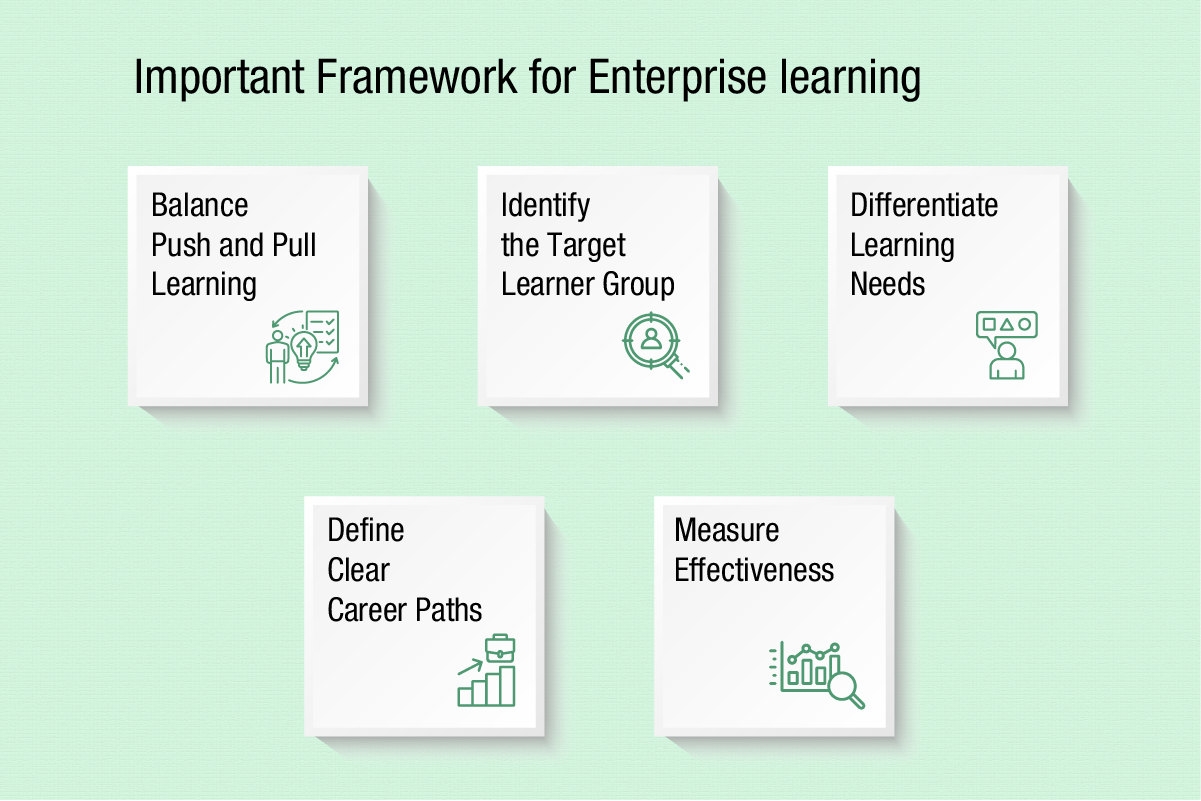
An effective Enterprise Learning Framework is essential for ensuring continuous employee growth and strategically aligning workforce development with the company's overarching goals. Modern frameworks must move beyond traditional, passive training by embracing a dual approach that addresses both mandatory enterprise needs and the individual's self-directed growth, thereby creating a more engaged, motivated, and highly effective workforce.
Balance Push and Pull Learning
A foundational element of a successful enterprise learning framework is integrating a balanced mix of "push" and "pull" learning methodologies. Push learning is a structured, top-down approach (like required e-learning modules or classroom training) that ensures all employees receive essential, standardized information dictated by enterprise needs, such as compliance or mandatory technical skills. Conversely, Pull learning is a self-directed, flexible approach where employees access resources (videos, articles, on-demand courses) aligned with their personal growth interests, improving engagement and knowledge retention because the learner is taking ownership of their development.
Identify the Target Learner Group
To maximize the Return On Investment (ROI) in training, the framework must clearly identify the target learner groups within the organization. Simply providing universal access to digital platforms is often insufficient. By focusing L&D efforts on specific, high-potential employees or teams where a skill gap creates the greatest business risk or opportunity, companies can ensure that the investment generates the intended business value. This focus allows for more precise resource allocation and better measurement of the program’s success.
Differentiate Learning Needs
Learning needs are not homogenous across a large organization; they vary significantly based on business unit and employee lifecycle stage. An effective framework must differentiate content delivery accordingly. For instance, front-line managers may require more mandatory, technical training related to operations, while senior executives might be offered voluntary, high-touch programs focused on leadership or career development. This tailored approach ensures that the training is relevant, which is key to boosting engagement and effectiveness.
Define Clear Career Paths
Clear and well-defined career paths are a powerful catalyst for a "pull" learning culture. When employees can visually map the required skills and competencies needed to advance up the corporate ladder, they become highly motivated to seek out and consume the necessary learning resources. Defining these paths acts as a compelling internal incentive, driving employees to proactively develop their skills and competencies, ultimately leading to a more engaged and motivated workforce.
Measure Effectiveness
Finally, the framework must incorporate mechanisms for regularly measuring effectiveness. This involves going beyond simple completion rates by collecting regular feedback and assessments on employees' learning progress, knowledge retention, and application in their roles. These continuous data points are crucial for identifying gaps in the learning delivery, validating the training's impact on job performance, and providing the necessary insights to modify the learning plan for continuous improvement.
Enterprise Learning Trends
As organizations aim for greater efficiency, several cutting-edge enterprise learning trends are emerging as essential components of a forward-thinking L&D strategy, shaping how companies will upskill, reskill, and future-proof their talent for years to come.
AI-Driven Skill Development
Artificial Intelligence (AI) has become crucial for Enterprise L&D. It moves training from a reactive to a proactive system by helping companies identify skills gaps in real-time and forecast futuristic upskilling requirements based on business trends. The trend advocates for a Human + AI approach, where technology enables professionals to thrive in partnership with AI, ensuring their knowledge stays aligned with rapidly evolving demands in areas like cloud computing and data science.
Hyper-Personalized Upskilling Method
Corporate L&D programs are shifting away from generic content toward hyper-personalized learning paths. This trend focuses on customizing content based on each learner's specific skills, job responsibilities, and career goals. Instead of training based on predefined roles, organizations are focusing on developing precise skills for each individual. This personalized approach leads to greater dexterity in the workforce and more effectively fills critical skill gaps.
Microlearning and On-Demand Content
With professionals facing increasingly tight schedules and busier workloads, micro learning is dominating L&D strategies. This trend involves delivering bite-sized content that can be consumed in minutes, making it ideal for mobile learning and reinforcing knowledge through quick repetition. This on-demand skilling allows employees to learn quickly and apply knowledge immediately, integrating training seamlessly into their daily workflow.
Immersive Learning Technologies
Immersive technologies like Augmented Reality (AR) and Virtual Reality (VR) are being heavily leveraged to create high-engagement training environments. Immersive learning allows professionals to engage in simulated environments to practice complex tasks, troubleshoot systems, or handle high-risk situations without the risk of the real world. This hands-on, simulated practice sets new benchmarks for experiential learning and knowledge retention.
Data-Driven Learning Strategies
Under pressure to prove the Return on Investment (ROI) of training, L&D strategies are becoming inherently data-driven. This trend involves using data analytics to optimize and customize training programs based on performance metrics, skill gaps, and learner feedback. Trainers collect and analyze information from learning management systems (LMS) and assessments to understand areas for improvement, enabling them to customize content in real-time and ensure training is directly connected to desired business outcomes.
Gamification and Social Learning
Engagement is key to successful corporate learning. Gamification is used to drive motivation and foster collaboration through game-based elements like quizzes, badges, leaderboards, and challenges. In parallel, Social Learning Platforms and internal interactive forums are transforming training by encouraging knowledge sharing, peer teaching, and group discussions, making learning a collaborative and dynamic experience essential for remote and hybrid teams.
How Mentorship Helps with Enterprise Learning
“A mentor is someone who sees more talent and ability within you than you see in yourself and helps bring it out of you.”
- Bob Proctor
Mentorship is far more than a simple piece of career advice; it is a strategic component of enterprise learning that bridges the gap between theoretical training and real-world application. By creating structured programs where experienced employees guide those with less experience, organizations foster an engaging environment for honest conversation, skill development, and critical knowledge sharing that formal training alone cannot provide.
Mentorship provides the essential context and real-world experience that traditional training often lacks. While a webinar can teach theory, a mentor offers hands-on, interactive guidance that helps a mentee apply newly acquired knowledge to complex, everyday challenges. This personalized support encourages self-reflection and creates a safe space for the mentee to ask questions and explore ideas without the fear of judgment, significantly sharpening their practical skills.
The benefits of mentorship are two-fold, extending significantly to the mentors themselves. By taking on the role of a guide, mentors strengthen essential leadership skills such as coaching, active listening, and communication. They also gain a renewed sense of purpose and are exposed to fresh perspectives from mentees, helping them see organizational gaps or spot new opportunities. This two-way learning makes the program an efficient tool for developing leaders at all levels.
Conclusion
Enterprise learning is no longer a support function confined to training programs. When approached strategically, it becomes a foundation for building a workforce that can adapt, innovate, and respond to evolving business demands.
Organizations that align learning with business priorities, adopt engaging development approaches, and leverage modern learning technologies position themselves to grow with confidence. In this environment, learning moves beyond skill maintenance to become a continuous driver of resilience, innovation, and long-term organizational success.