
Managing IT environments is now central to keeping digital operations running without disruption. As businesses grow and their technology ecosystems expand, the need for reliable oversight of systems, applications, and infrastructure becomes more pronounced. In this context, Remote Infrastructure Management (RIM) has emerged as a strategic solution that enables organizations to supervise and support their IT environments from offsite locations.
It offers a more proactive and structured approach maintaining system performance, stability, and continuity, regardless of where teams or infrastructure are based.
Evolution of Remote Infrastructure Management
Infrastructure management was primarily an on?site activity, dependent on physical access to servers, networking equipment, and data centres. Teams were required to be physically present to troubleshoot issues, install updates, or perform maintenance tasks.
As organizations began expanding across multiple locations, the pressure to manage growing IT environments more efficiently led to the adoption of remote monitoring tools. However, the introduction of virtualization and centralized management consoles marked a major shift, allowing administrators to interact with multiple systems from a single interface.
The rise of cloud computing further accelerated this evolution, enabling infrastructure to be controlled, configured and scaled without geographical constraints. Automation and orchestration tools made it possible to manage routine tasks remotely, reducing reliance on hands?on intervention.
Over time, Remote Infrastructure Management has grown from a reactive support model to a strategic, technology?driven discipline that empowers businesses to maintain resilient and agile IT operations across distributed environments.
Core Components of Remote Infrastructure Management
Remote Infrastructure Management (RIM) encompasses a wide range of IT functions that allow organizations to maintain their technology environments remotely. The components that work together are listed are as follows:
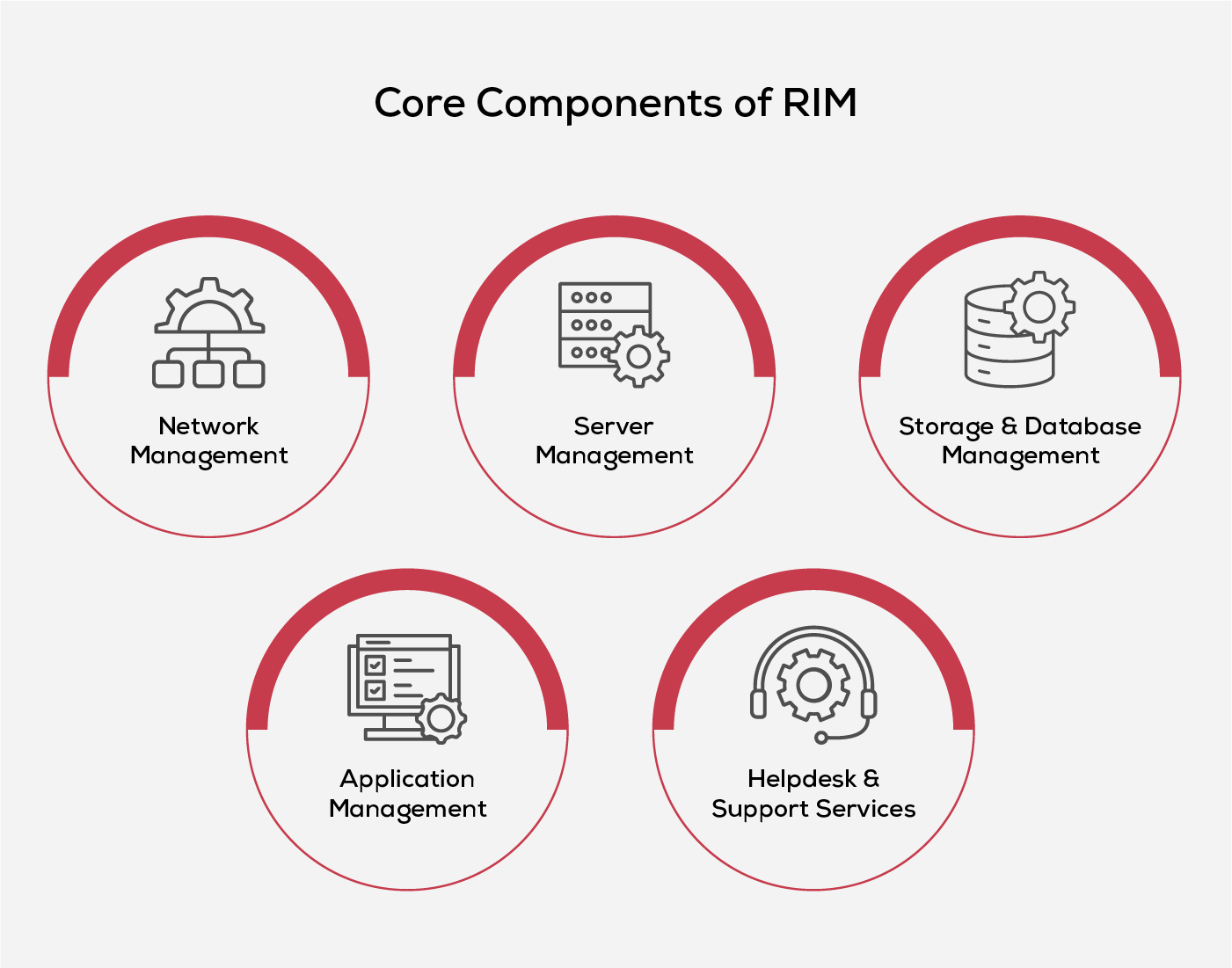
Network Management
Network management involves the remote monitoring and administration of routers, switches and other connectivity components to ensure uninterrupted communication between systems. It includes performance optimization and issue detection to keep business?critical services reachable and stable.
Server Management
Server management includes provisioning, configuring, patching and troubleshooting physical and virtual servers. Its purpose is to maintain high availability and optimal performance, regardless of whether servers are located in data centres, colocation facilities or cloud environments. Effective remote server management minimizes downtime, accelerates issue resolution and supports scaling demands.
Storage & Database Management
This component centres on safeguarding information assets. Storage responsibilities include organizing data repositories, arranging backup routines, and managing recovery workflows. Database tasks concentrate on maintaining structured datasets, refining performance and securing critical records to ensure dependable retrieval and long?term integrity.
Application Management
Application management focuses on keeping business platforms aligned and responsive at all times. It includes coordinating version updates, monitoring performance behaviour and addressing issues that may affect usability so essential tools remain dependable for employees and customers.
End-User Device Management
End-user device management deals with the setup, upkeep, and security of employee devices such as laptops, desktops, and mobile phones. It covers activities like deploying updates, resolving device-level issues remotely, managing software installations, and maintaining visibility over devices to support consistent usage and controlled access.
Security Management
Security management addresses the protection of IT environments against unauthorized access and evolving threats. It applies measures such as access controls, authentication layers, monitoring mechanisms, and periodic evaluations to reduce exposure to risks and meet compliance expectations.
Benefits of Remote Infrastructure Management
Remote Infrastructure Management (RIM) delivers operational, financial, and strategic advantages by enabling organizations to maintain robust technology environments supported by continuous oversight, automation, and off?site expertise.
- Cost efficiency and reduced operational overhead
By shifting infrastructure operations into remote workflows, companies avoid unnecessary on?site visits, trim physical resource usage, and streamline tooling into unified systems. This reduction in fragmented processes and localized maintenance directly lowers operational burden and overall spend.
- 24/7 monitoring and proactive issue resolution
Continuous visibility over systems makes it possible to detect problems early and respond quickly. Intelligent alerts allow timely intervention, limiting user impact and minimizing service interruptions.
- Enhanced scalability and flexibility
RIM supports environments that span across data centres, cloud platforms, and remote locations, allowing organizations to adjust capacity or coverage without major structural changes. This flexibility helps teams adapt to new workloads and expanding requirements smoothly.
- Access to Specialized Expertise
Remote models give organizations direct access to skilled professionals and advanced tools without the need to build large internal teams. This expands technical capability while reducing the cost and effort of maintaining expertise in-house.
- Improved business continuity and disaster preparedness
Centralized visbility and remote operability help maintain steadiness during unexpected events. With systems managed off?site, organizations can continue operating even when physical environments face disruptions, supporting stronger continuity and recovery outcomes.
Role of RIM in Supporting Remote and Hybrid Workforces
Hybrid work demands that employees can move between home, office, and on-the-go environments without friction. This shift places new expectations on IT, where access, performance, and support must remain consistent regardless of location.
Remote Infrastructure Management (RIM) aligns with this need by keeping systems and operations centrally managed while employees connect from anywhere. Whether teams are logging in from corporate networks or remote setups, applications and resources remain equally accessible, without reliance on physical IT intervention.
As hybrid models evolve, RIM makes it easier to extend IT support across users in multiple locations , onboard new devices, and maintain uniform standards across environments. It brings structure to how systems are maintained and accessed, even when the workforce is widely dispersed.
This approach allows organizations to sustain a flexible work model without compromising on operational stability, giving employees a consistent experience while IT teams manage a more dynamic, location-independent setup.
RIM vs DCIM
Remote Infrastructure Management (RIM) and Data Center Infrastructure Management (DCIM) operate at different layers of IT, each addressing a distinct aspect of infrastructure. RIM is centered on the management of IT systems such as servers, networks, applications, and end-user devices through remote access and centralized control. DCIM, in contrast, focuses on the physical environment that supports these systems, including power, cooling, hardware layout, and facility conditions.
The difference lies in their scope, while RIM deals with how systems run and are accessed across geographically spread setups, DCIM concentrates on where and how the infrastructure is physically housed and maintained. Together, they provide a more complete view of IT operations by covering both the operational and facility sides of infrastructure.
A quick comparison of the key differences is outlined below:
| Aspect | RIM (Remote Infrastructure Management) | DCIM (Data Center Infrastructure Management) |
|---|---|---|
| Primary Focus | IT systems and workloads | Physical data center environment |
| Scope | Servers, networks, applications, databases, end-user devices | Power systems, cooling, racks, cabling, environmental conditions |
| Management Layer | Logical / operational layer | Physical / facility layer |
| Access Model | Remote and centralized | On-site visibility with integrated tools |
| Objective | Maintain system performance and accessibility | Optimize resource usage and physical infrastructure health |
| Environment Coverage | Distributed, hybrid, and cloud environments | Primarily data center facilities |
Future Trends in Remote Infrastructure Management
Advances in automation and distributed computing are shaping how Remote Infrastructure Management operates across hybrid environments, with a stronger focus on resilience and adaptability.
Use of AI?driven Autonomous Operations
AI and Machine?Learning capabilities are becoming central to remote management, facilitating systems to detect anomalies earlier, forecast issues and make informed adjustments without manual intervention. These intelligence?driven functions strengthen operational resilience and reduce the need for constant human monitoring.
Rise of Edge Computing
With data processing moving closer to its source, edge computing is expanding the boundaries of IT infrastructure. This setup calls for stronger oversight across multiple locations. RIM will be central to managing these environments and maintaining consistency. It will help organizations keep edge and core systems aligned as operations scale.
Shift Towards Hybrid Multi?Cloud Models
Future RIM platforms are expected to deliver integrated dashboards and automated coordination across public, private, and hybrid cloud infrastructures driving consistency in performance, security, and compliance.
Robust Security Integrated in Infrastructure Operations
A clear shift is underway as security and infrastructure operations move closer together. Instead of operating independently, security controls are being woven into routine management workflows, supported by AI-driven threat detection that enhances visibility into emerging risks. This alignment makes compliance and risk management a continuous part of operations.
Why Inspirisys is Your Trusted Partner?
Managing modern IT environments requires consistency, control, and the ability to adapt quickly. At Inspirisys, our Remote Infrastructure Management (RIM) services are built to support distributed operations with structured processes and experienced teams that keep systems running reliably.
We extend this capability with end-to-end cloud management across AWS, Azure, and GCP, focusing on cost optimization, resource efficiency, and adherence to regulatory standards. Our compliance support spans over 35 frameworks, including HIPAA, PCI-DSS, GDPR, CCPA, and SOC 2/3, helping organizations stay aligned with evolving requirements.
By combining operational discipline with practical expertise, we enable businesses to manage complexity while keeping their IT environments efficient, compliant, and ready to scale.
Frequently Asked Questions
1. How can organizations keep infrastructure secure when using RIM?
Organizations can maintain infrastructure security in RIM environments by implementing strong encryption, enforcing strict access controls, and selecting solutions that comply with standards such as SOC 2 and ISO 27001. Together, these measures help protect data while enabling secure remote operations.
2. What industries benefit most from RIM in multi-cloud environments?
Industries such as banking, healthcare, retail, and manufacturing benefit significantly due to their need for high availability, compliance, and secure data management.
3. Who should consider adopting RIM?
RIM is a good fit for organizations that want to manage their IT systems more efficiently without depending on on-site teams. It is particularly useful for businesses with expanding infrastructure, remote work models, or increasing operational complexity.
4. What should organizations consider when evaluating a RIM partner or tool?
Focus on how well the provider fits your IT setup and business needs. Look at their technical expertise, service reliability, security practices, and ability to support your scale. It’s also important that they offer clear visibility into operations and can adapt as your infrastructure evolves.