
Growing demand for AI, cloud computing, and real-time digital services is reshaping the data center industry, driving organizations to rethink how data center infrastructure is planned, built, and managed. As businesses generate and process unprecedented data volume, the need for scalable, efficient, and resilient facilities continues to grow.
This shift is accelerating data center growth worldwide while raising expectations for performance, energy efficiency, and operational reliability. At the same time, constraints around power availability, sustainability goals, and increasing infrastructure costs are influencing how organizations approach long-term investments.
To meet these evolving demands, data center technology is advancing to support higher computing densities, greater operational efficiency, and future-ready infrastructure. Understanding the forces shaping the industry will help organizations make informed decisions and prepare for the next phase of digital transformation.
Top Trends in the Data Center Industry
Organizations are prioritizing data center modernization and data center automation, to improve performance, optimize resources, and support long-term business growth. The following data center trends are expected to influence technology investments, data center operations, and infrastructure planning in 2026 and beyond.
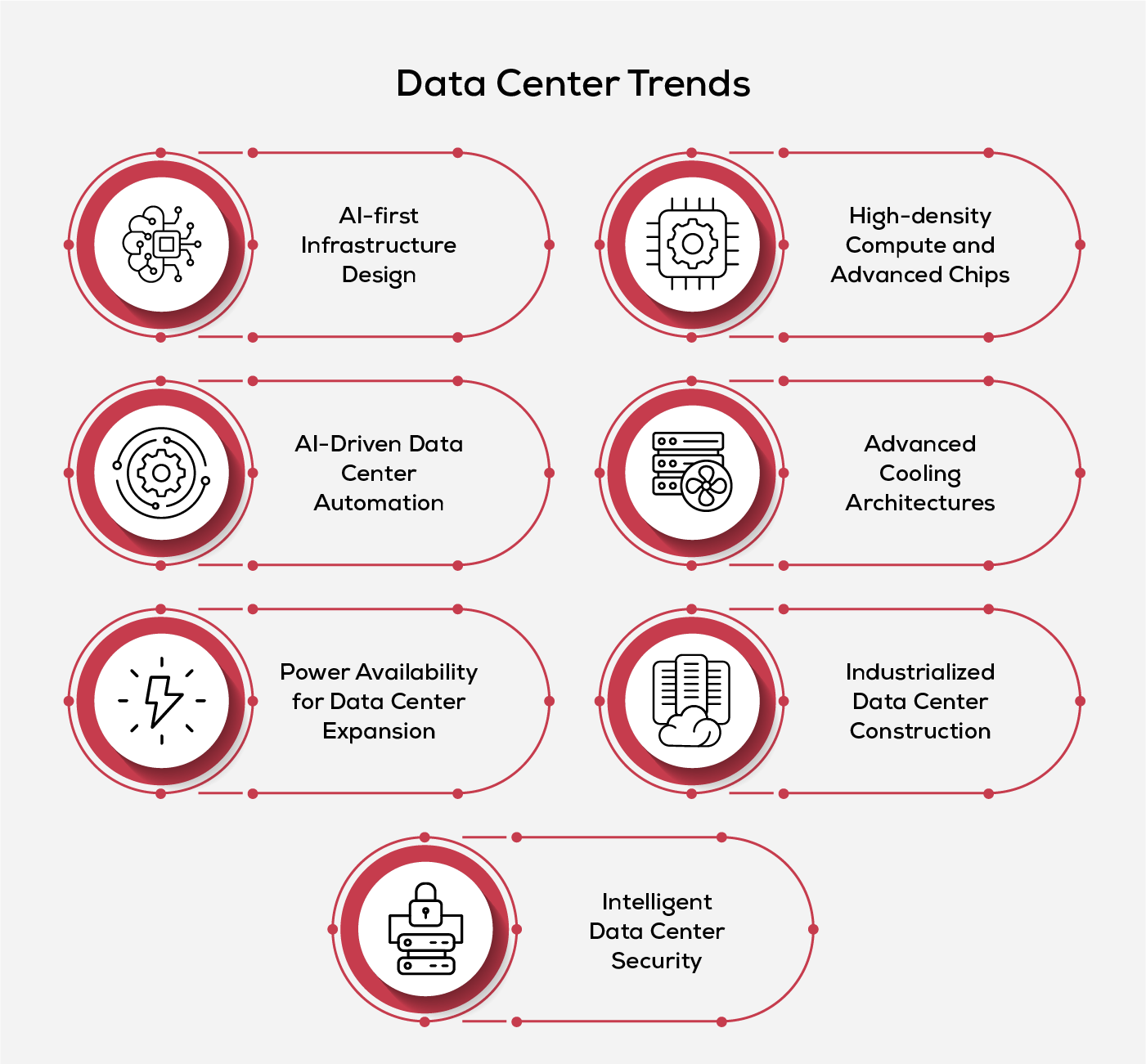
1. AI-first Infrastructure Design
Artificial intelligence has become the primary factor influencing how modern data centers are planned and expanded. Rather than adapting existing facilities for AI workloads, organizations are investing in AI data centers designed to support large-scale AI applications while balancing performance, scalability, and operational efficiency.
Infrastructure requirements also vary by workload. AI model training continues to rely on hyperscale data centers with massive compute capacity, while inference workloads are increasingly deployed through edge data centers to deliver low-latency performance for real-time applications. This combination of centralized and distributed computing is changing how organizations plan capacity and allocate infrastructure resources.
AI-first infrastructure planning now guides capacity expansion, deployment models, and strategic investment decisions across enterprise, cloud, and edge environments.
2. High-density Compute and Advanced Chips
The growing demand for AI and high-performance computing is significantly increasing compute density within modern data centers. More processing power is now being deployed within the same physical footprint, driving higher rack power requirements and placing greater demands on supporting infrastructure.
At the same time, computing architectures are becoming increasingly heterogeneous. Instead of relying on uniform server configurations, operators are combining CPUs, GPUs, and specialized AI accelerators to match hardware with specific workload requirements. This approach improves resource utilization while delivering better performance for diverse computing environments.
As compute clusters continue to scale, high-speed communication between processors, memory, and storage has become equally important. Advanced interconnect technologies help reduce latency, eliminate performance bottlenecks, and support efficient data movement across distributed workloads. Together, these developments are redefining how modern data centers are designed to deliver sustained performance at scale.
3. AI-Driven Data Center Automation
AI is transforming data center operations by automating routine management tasks, improving infrastructure visibility, and enabling faster operational decisions. Instead of relying on reactive monitoring, operators are using AI and machine learning to analyze infrastructure data, detect anomalies, predict equipment failures, and optimize resource utilization before issues affect performance.
Automation also streamlines capacity planning, workload management, and infrastructure maintenance by continuously analyzing operational conditions and recommending corrective actions. These capabilities reduce manual intervention, improve system availability, and help operators manage increasingly complex computing environments with greater efficiency.
Data center automation has become a core operational requirement for managing increasingly complex infrastructure and workloads.
4. Advanced Cooling Architectures
Advanced data center cooling systems now play a central role in facility design, supporting the thermal demands of modern computing environments. Traditional air cooling cannot efficiently manage the heat generated by AI workloads and power-intensive racks, making liquid cooling technologies such as direct-to-chip and immersion cooling a practical requirement for many deployments.
These cooling architectures remove heat more efficiently, reduce data center energy consumption, and support higher computing densities without compromising system reliability. Cooling architecture is closely integrated with power distribution, equipment placement, and facility design, helping operators support higher workloads while advancing data center sustainability.
5. Power Availability for Data Center Expansion
Power availability now plays a decisive role in data center expansion. Gartner forecasts global data center electricity consumption to reach 565 TWh in 2026, a 26% increase over 2025, driven largely by AI workloads. As electricity demand continues to rise, access to reliable power is influencing site selection and capacity planning as much as land, connectivity, and business demand.
To address these constraints, organizations are investing in renewable energy, battery storage, and intelligent power management systems that improve energy resilience and reduce dependence on traditional power sources. Traditional metrics such as Power Usage Effectiveness (PUE) are also being complemented by granular energy monitoring, providing real-time visibility into power consumption across critical infrastructure. This enables operators to optimize energy use, maximize available power capacity, and support future data center expansion.
6. Industrialized Data Center Construction
Industrialized construction is reducing the time required to build and expand modern data centers. Instead of relying entirely on traditional on-site construction, operators are using factory-built components and modular data centers to accelerate deployment, improve build quality, and reduce project complexity.
Pre-engineered modules provide greater consistency across deployments while improving cost predictability and construction efficiency. They also allow operators to expand data center capacity incrementally, responding faster to growing demand without waiting for large-scale facility buildouts.
As hyperscale investments continue to increase, industrialized construction offers a practical approach to scaling infrastructure while maintaining reliability, operational consistency, and delivery timelines.
7. Intelligent Data Center Security
Security is embedded across every layer of modern data center infrastructure, combining physical safeguards with intelligent cybersecurity to protect critical assets and maintain operational resilience. Rather than relying on perimeter-based defenses, operators are implementing Zero Trust principles that continuously verify users, devices, and workloads before granting access.
Physical security extends beyond conventional surveillance. Biometric authentication, AI-powered video analytics, intelligent perimeter monitoring, and automated threat detection provide continuous visibility and faster incident response across data center facilities.
Cybersecurity capabilities are advancing in parallel through AI-driven threat detection, behavioral analytics, stronger encryption, and automated response mechanisms. Together, these technologies strengthen data center security, helping operators identify threats earlier, reduce security risks, and safeguard increasingly distributed and high-value computing environments.
Conclusion
Technology priorities will continue to change, but the need for adaptable infrastructure will remain constant. Organizations that view data center modernization as an ongoing strategic initiative rather than a one-time project will be better positioned to accommodate changing workloads, business priorities, and technology requirements.
These trends provide a practical framework for evaluating infrastructure investments, identifying modernization opportunities, and making informed decisions that support operational performance and business growth well beyond 2026.
Frequently Asked Questions
1. What are the four main types of data centers?
The four main types of data centers are enterprise, colocation, cloud, and edge data centers. Each serves a different purpose, ranging from supporting an organization's internal IT infrastructure to delivering cloud services or processing data closer to users for low-latency applications.
2. How do AI data centers differ from traditional data centers?
Traditional data centers are designed to support general enterprise workloads such as business applications, databases, virtual machines, and web services. AI data centers, in contrast, are purpose-built for compute-intensive AI training and inference workloads. They use GPU-accelerated infrastructure, support much higher rack densities, require high-speed networking and storage, and rely on advanced cooling systems to manage significantly greater power and heat loads.
3. How is data center capacity planning changing?
Capacity planning is shifting from fixed, long-term forecasts to a more flexible approach that aligns infrastructure expansion with workload growth, power availability, and business demand. This helps operators scale capacity efficiently while optimizing resource utilization.
4. Why is the data center skills gap becoming a growing concern?
As data centers adopt AI, high-density computing, automation, and advanced cooling technologies, the demand for specialized skills continues to increase. Organizations are finding it more challenging to recruit and retain professionals with expertise in managing modern data center infrastructure, making workforce development a growing priority.