
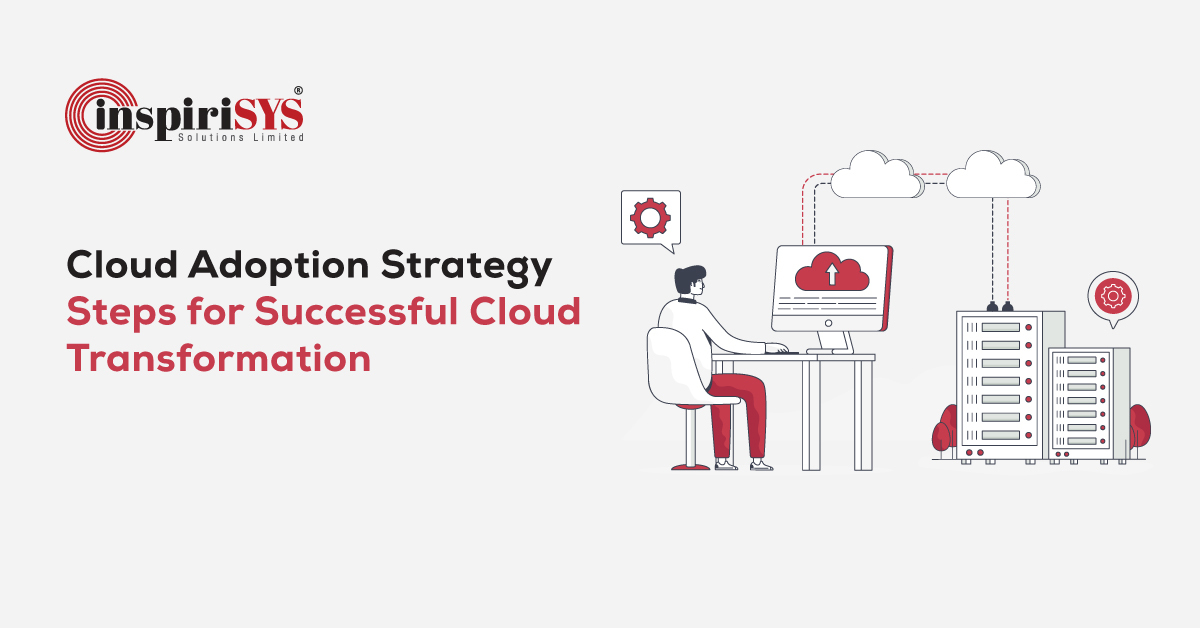
Cloud adoption has become a strategic priority for organizations looking to improve agility, scale operations and support innovation. Yet moving to the cloud is rarely as simple as migrating applications from one environment to another. Without a clear approach, businesses can encounter unexpected costs, security challenges, and operational disruptions and missed opportunities.
In this guide, we'll explore the key considerations and decisions involved in developing a cloud integration strategy, from planning and preparation to implementation and continuous optimization.
What is a Cloud Adoption Strategy
A cloud adoption strategy is a structured framework that helps organizations plan, implement, and manage cloud adoption in a way that supports their business priorities. Rather than treating cloud migration as a standalone IT initiative, it provides clarity for making technology, operational, and investment decisions throughout the cloud transformation journey.
It establishes the foundation for cloud adoption by defining a clear approach before implementation begins. This enables organizations to steer cloud transformation with greater clarity, consistency, and confidence while adapting to changing business and technology needs
Why Cloud Adoption is a Business Priority
Organizations across industries are accelerating cloud adoption as part of broader digital transformation initiatives. Rapid advances in artificial intelligence, automation, data analytics, and cloud-native application development have increased the demand for modern IT environments capable of supporting evolving business requirements.
At the same time, distributed workforces, growing data volumes, changing customer expectations, and evolving regulatory requirements are reshaping enterprise technology landscapes. Traditional on-premises infrastructure often struggles to deliver the agility and scalability needed to respond effectively to these changes.
Steps to Build a Cloud Adoption Strategy
For organisations looking to migrate to the cloud or enhance their existing cloud capabilities, the following steps outline a strategic path to successful adoption and long-term operational efficiency.
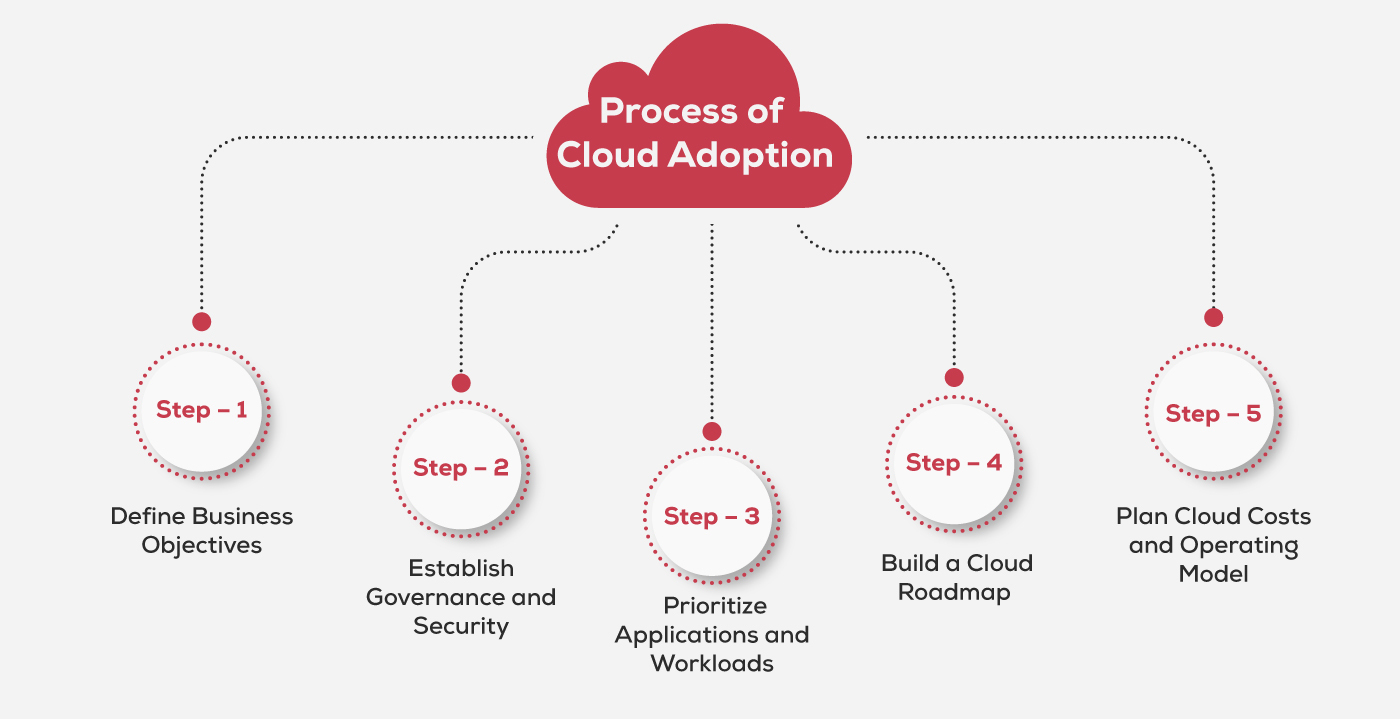
Step - 1: Define Business Objectives
To maximise the value of cloud adoption, organisations should align cloud initiatives with business objectives rather than focusing solely on technology. Engage key stakeholders to define clear, measurable goals and prioritise initiatives that deliver the greatest business impact. A well-defined adoption framework should support both current requirements and long-term enterprise cloud strategy.
Step - 2: Establish Governance and Security
Create governance policies that define security standards, access controls, compliance requirements, and operational responsibilities before cloud implementation begins. Establishing these guardrails early helps reduce risk, maintain regulatory compliance, and ensure consistent management across cloud environments.
Step - 3: Prioritize Applications and Workloads
Before migrating to the cloud, assess your existing applications, systems, and workloads to determine which are best suited for cloud environments. Consider factors such as business criticality, performance requirements, technical dependencies, scalability, and migration complexity when deciding the order of adoption.
Prioritise applications that can benefit most from cloud capabilities while identifying legacy systems or dependencies that may require modernisation, replacement or a phased migration approach.
Step - 4: Build a Cloud Roadmap
Create a phased roadmap that defines implementation milestones, timelines, resource requirements, dependencies, and success metrics. A clearly documented plan helps coordinate activities across teams, monitor progress, and keep cloud initiatives on schedule.
Step - 5: Plan Cloud Costs and Operating Model
Estimate implementation and migration costs, establish realistic budgets, and define an operating model for managing cloud resources over time. Include cloud cost management practices that account for infrastructure consumption, temporary parallel environments, and future scaling requirements.
Clearly assigned operational responsibilities and financial controls help organizations optimize spending while maintaining long-term operational efficiency.
How to Assess Cloud Readiness
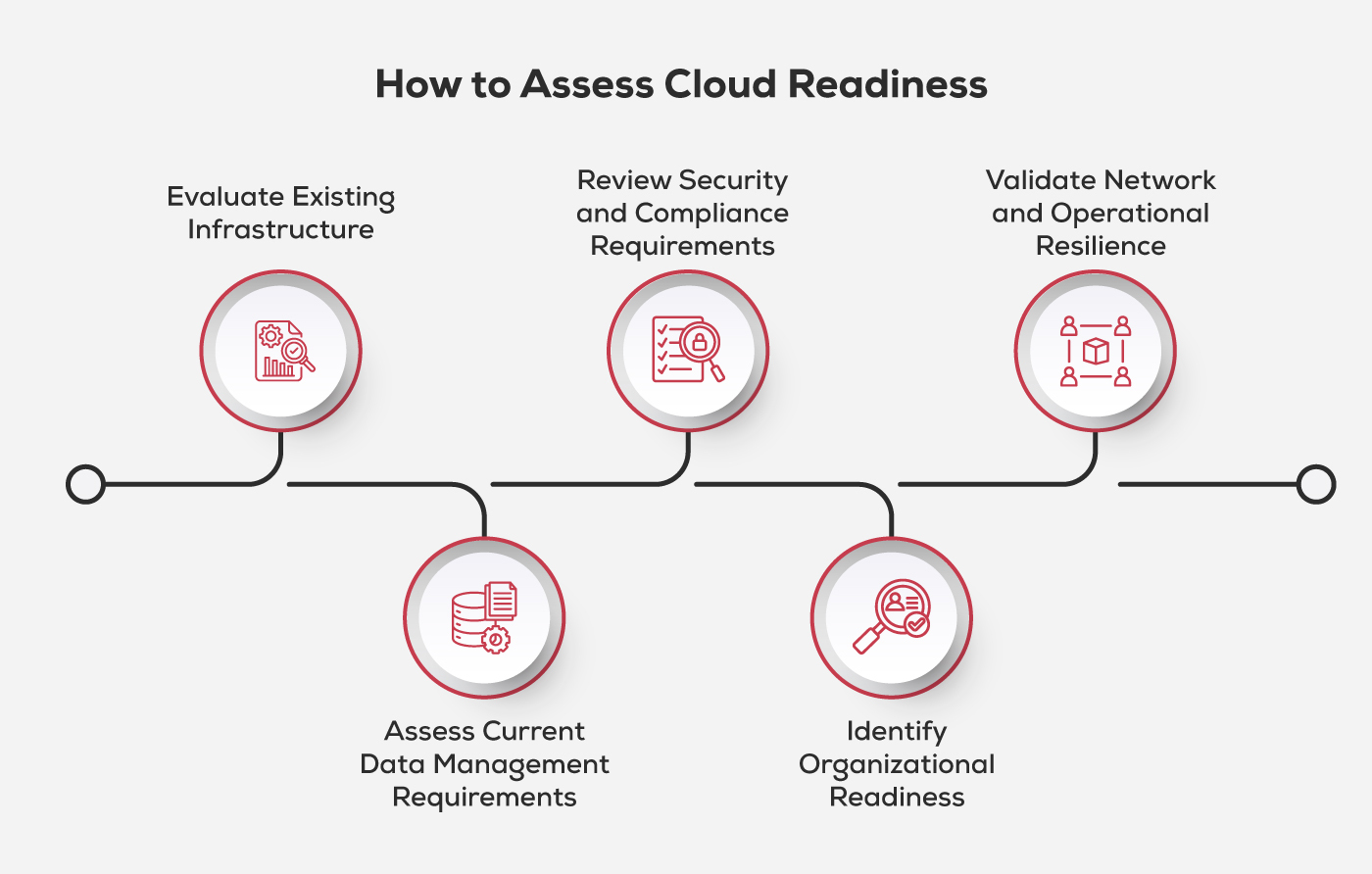
A cloud readiness assessment helps identify potential risks, uncover dependencies and determine the most effective migration approach. By evaluating technical, security and organizational factors upfront, businesses can avoid costly surprises later in the adoption journey.
1. Evaluate Existing Infrastructure
Create a comprehensive inventory of applications, infrastructure, and technology assets to understand the current IT landscape. Examine system dependencies, architecture, resource utilization, and modernization requirements to determine how existing environments may perform in the cloud and where technical changes may be required.
2. Assess Current Data Management Requirements
Examine how data is stored, accessed, and shared across systems to determine the most appropriate data migration and storage strategy. Review data quality, classification, retention policies, and availability requirements to help preserve data integrity throughout the transition.
3. Review Security and Compliance Requirements
Analyse existing security controls, regulatory obligations, and compliance requirements to determine whether additional safeguards are needed in the target cloud environment. Evaluate encryption standards, Identity and Access Management, audit capabilities, and data protection practices to help uncover vulnerabilities and strengthen security before workloads are transitioned.
4. Identify Organizational Readiness
Assess whether your workforce has the skills, defined roles, and supporting processes needed to operate in a cloud environment. Address capability gaps through targeted training and change management to strengthen cloud operations and sustain long-term adoption.
5. Validate Network and Operational Resilience
Review network connectivity, bandwidth, monitoring capabilities, backup mechanisms, disaster recovery preparedness, and integration requirements to ensure the existing environment can reliably operate in a cloud ecosystem. Resolving infrastructure and operational limitations early helps minimize disruption during the transition.
Choosing the Cloud Deployment Options
The choice of deployment model influences how applications are hosted, data is managed, and IT resources are delivered. Understanding the strengths of each option and the capabilities offered by different cloud service providers helps identify the most suitable environment for different business and technical scenarios.
Private Cloud
A private cloud provides dedicated infrastructure and resources for a single organization. This model offers greater control over the environment, making it a preferred option for businesses that handle sensitive data, operate in highly regulated industries or require strict governance and could compliance controls.
Public Cloud
A public cloud delivers services through infrastructure managed by a third-party cloud provider. Public cloud environments are highly scalable and allow organizations to access computing resources on demand without investing heavily in physical infrastructure.
Hybrid Cloud
A hybrid cloud combines elements of both private and public cloud environments. This approach allows organizations to retain sensitive workloads or regulated data in a private environment while leveraging the cloud scalability and flexibility of the public cloud for less critical applications.
The most suitable deployment model is ultimately the one that aligns with the organization's requirements, risk profile and enduring growth strategy.
How to Select the Right Cloud Service Provider
Selecting a cloud service provider involves more than comparing features or pricing. Consider how well the provider's platform, expertise, and service capabilities align with your operational and regulatory expectations.
- Review the provider's service portfolio, integration capabilities, and platform maturity to ensure compatibility with your application landscape.
- Verify compliance certifications, data protection practices, and industry-specific regulatory support.
- Compare geographic coverage and data center presence to address latency, availability, and data residency requirements.
- Examine service-level agreements (SLAs), technical support, implementation expertise, and product roadmap to understand the level of ongoing commitment.
- Look for transparent pricing, detailed billing insights, and built-in cost optimization features that improve financial visibility.
Conclusion
Cloud adoption delivers the greatest value when every decision, from planning and deployment to ongoing operations, is based on the unique needs of the organization rather than a standardized approach. While internal expertise plays an important role, experienced cloud specialists can help simplify complex decisions, reduce implementation challenges, and accelerate outcomes with proven best practices.
With end-to-end cloud consulting, migration, modernization, managed services, and optimization capabilities, Inspirisys Cloud Services enables organizations to adopt cloud technologies with greater clarity and confidence. Backed by deep technical expertise and proven delivery experience, we help enterprises build cloud environments that are secure, scalable, and ready to support future business demands.
Frequently Asked Questions
1. Can organizations move only certain workloads to the cloud?
Yes. Cloud adoption does not require moving every application or system. Many organizations adopt a phased approach, migrating specific workloads that can benefit most from cloud capabilities while retaining others in on-premises or private environments.
2. How can organizations avoid vendor lock-in?
Organizations can reduce vendor lock-in risks by adopting open standards, designing portable architectures, using containerized applications where appropriate, and considering hybrid or multi-cloud strategies. Planning for portability early can provide greater flexibility in the future.
3. What is the difference between cloud migration and cloud adoption?
Cloud migration refers to the process of moving applications, data, or infrastructure to the cloud. Cloud adoption is broader and includes the strategy, governance, operational changes, skills development and ongoing optimization required to successfully leverage cloud technologies across the organization.
4. Why is a cloud adoption strategy important?
Without a clear strategy, cloud adoption can lead to unexpected costs, security risks, and operational inefficiencies. A well-defined approach helps organisations maximise the value of their cloud investments while supporting scalability, agility, and long-term growth.