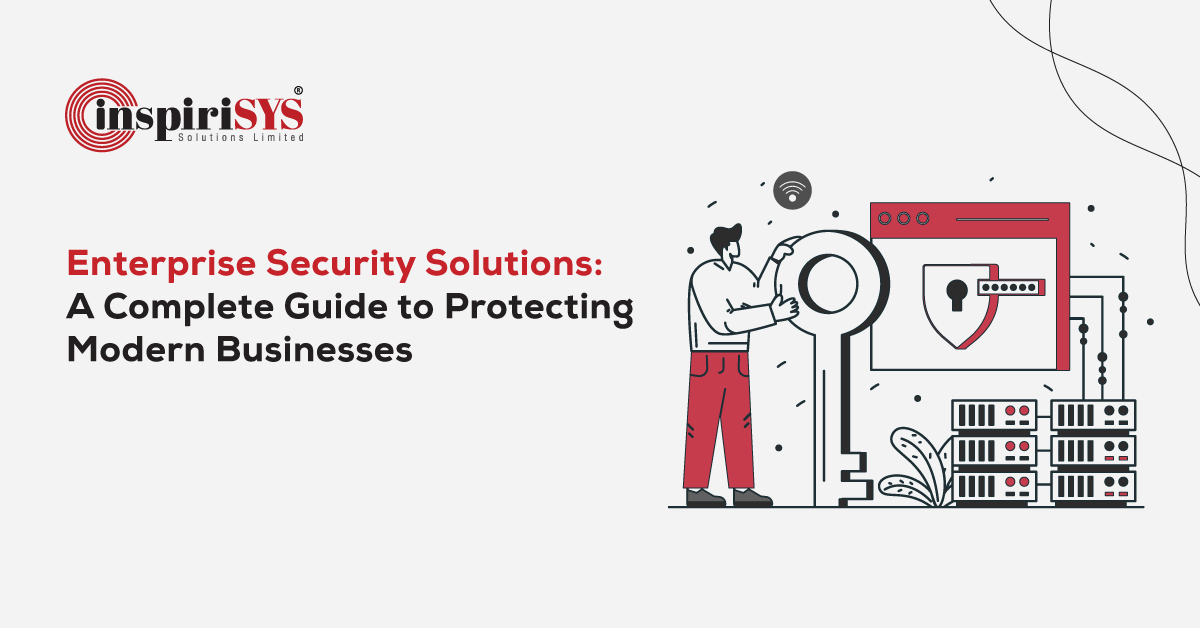
Enterprise security has become a business-critical priority as organizations rely more heavily on digital systems, distributed teams, and interconnected platforms. What was once managed with a handful of standalone security tools now requires a coordinated, enterprise-wide approach. Data flows across cloud environments, employees access systems from multiple locations, and applications integrate with numerous third-party services, all of which expand the attack surface and increase cybersecurity risks.
Enterprise security solutions provide the protection organizations need to secure modern IT environments while enabling business continuity and digital growth. This article provides a comprehensive overview of enterprise security, covering its importance, core components, business benefits, future trends, and key considerations for selecting the right solution.
What Are Enterprise Security Solutions
Enterprise security solutions provide the technologies, policies, and operational practices organizations use to manage security across the business. Rather than relying on isolated security tools, they create a unified security architecture that helps defend against both internal and external threats while protecting people, physical assets and sensitive data.
It combines physical and digital safeguards because vulnerabilities in one area can affect the other. For example, inadequate physical access control can allow unauthorized individuals to access critical systems, increasing the risk of a data breach.
A robust security typically includes access control, video surveillance, alarm systems, lighting systems, and a comprehensive cybersecurity strategy. These measures are supported by well-defined security policies and employee awareness programs that promote secure login practices, enable Single Sign-On (SSO), and strengthen data breach prevention through Multi-Factor Authentication.
Why Enterprise Security Solutions Matter
The modern threat landscape demands more than traditional security controls. Organizations need corporate security measures supported by effective risk management and a strong security infrastructure to address evolving cyber threats.
- Rising Complexity of Cyber Threats
Modern cyber threats extend far beyond phishing and malware to include AI-driven attacks, Advanced Persistent Threats (APTs), zero-day exploits, and sophisticated social engineering techniques. As cloud adoption and interconnected IT environments increase, organizations require enterprise security solutions that provide continuous visibility, detect suspicious activity early, and enable faster response to emerging threats.
- Remote Work and Expanding Endpoint Security
Hybrid work has significantly increased the number of devices accessing corporate networks. Employees now connect through personal devices (BYOD), remote locations, and SaaS applications, expanding the attack surface. Effective endpoint security helps organizations secure users, devices, and business data while supporting a flexible workforce.
- Regulatory Compliance and Business Trust
Organizations across industries must comply with stringent data protection and cybersecurity regulations while safeguarding sensitive information. A strong security infrastructure supports regulatory compliance by enforcing security policies, strengthening access controls, and improving visibility into security activities. It also reduces the risk of a data breach and strengthens customer trust by protecting business data and information.
- Need for Rapid Incident Response
Cyber incidents such as ransomware and system breaches can disrupt operations, resulting in financial losses and operational downtime. Modern IT security solutions enable organizations to detect, contain, and respond to incidents quickly by automating critical response actions, limiting the spread of threats, and supporting business continuity.
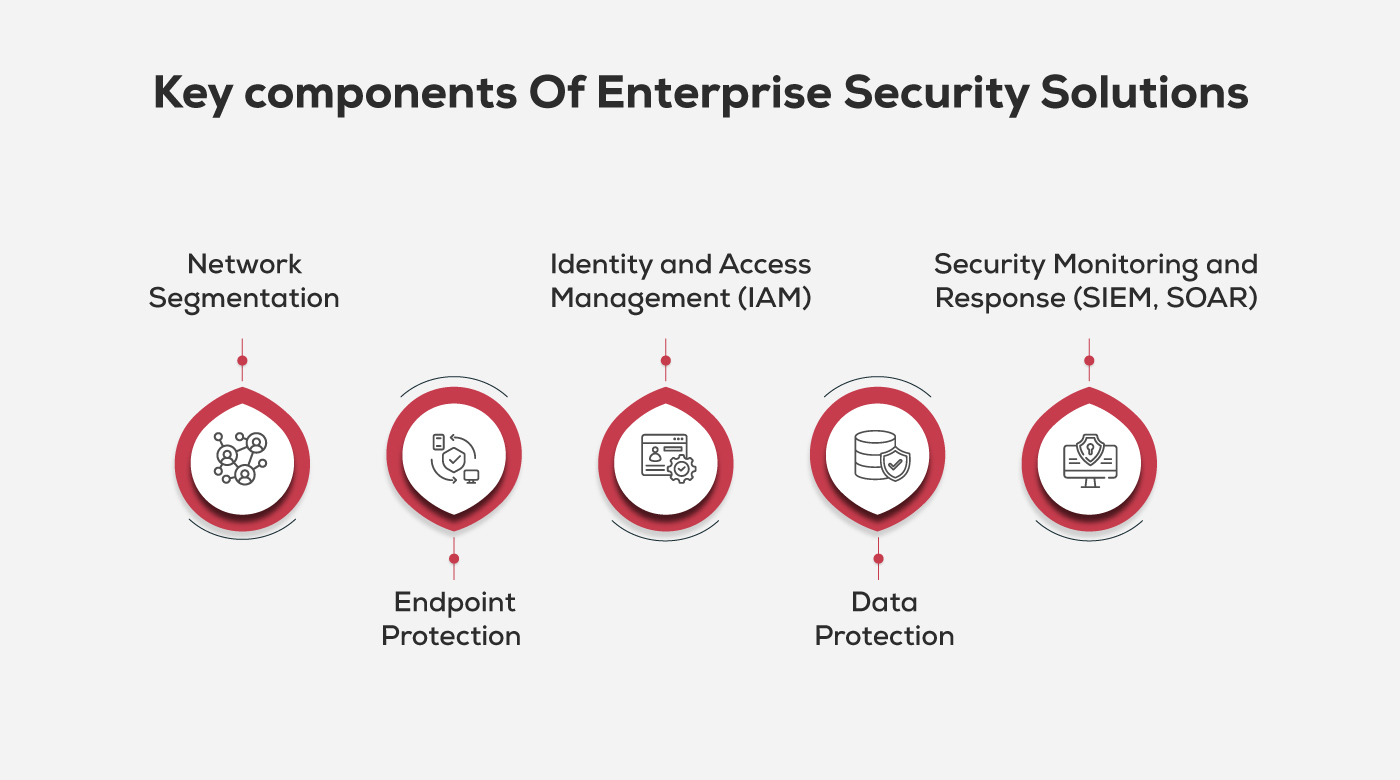
Key components of Enterprise Security Solutions
Effective enterprise security depends on multiple interconnected components rather than a single security control. Together, these capabilities help organizations protect users, systems, data, and infrastructure against evolving threats.
Network Segmentation
Network segmentation divides a network into smaller, isolated segments to limit the impact of security incidents and prevent attackers from moving laterally across systems. Critical applications, such as finance or HR systems, can be placed in separate network zones with stricter security controls. By improving visibility into network traffic and reducing unauthorized access between segments, network security becomes more effective and strengthens the overall enterprise security framework
Endpoint Protection
Endpoint security focuses on protecting devices such as laptops, mobile phones, and servers from threats like malware, ransomware, and fileless attacks. Modern endpoint protection goes beyond signature-based detection by using behavior-based analysis to identify suspicious activity and stop emerging threats. Centralized management consoles enable IT teams to monitor, update, and secure thousands of endpoints efficiently from a single platform.
Identity and Access Management (IAM)
Identity and Access Management (IAM) solutions manage digital identities, user authentication, permissions, and access policies to ensure that only authorized users can access business resources. Features such as Multi-Factor Authentication (MFA) add an extra layer of verification, making it significantly harder for attackers to misuse compromised credentials. By strengthening authentication and access controls, IAM helps reduce unauthorized access and minimizes identity-based cyber threats.
Data Protection
Data protection safeguards sensitive information throughout its lifecycle. Two key measures that support data protection are Encryption and Data Loss Prevention (DLP). Encryption ensures that only authorized users can access data, while DLP helps prevent sensitive information from being shared, transferred, or exposed without authorization. Together, they reduce the risk of data breaches and data leaks across enterprise environments.
Security Monitoring and Response (SIEM, SOAR)
SIEM platforms collect and centralize logs from multiple sources, giving organizations a unified view of their security environment. By analyzing network activity, user behaviour, and system events in real time, SIEM helps detect unusual patterns that may signal a threat.
SOAR complements SIEM by enabling automated responses to these threats. It uses predefined workflows to handle tasks such as isolating affected systems, triggering alerts and initiating response actions without manual intervention.
Benefits of Enterprise Security Solutions
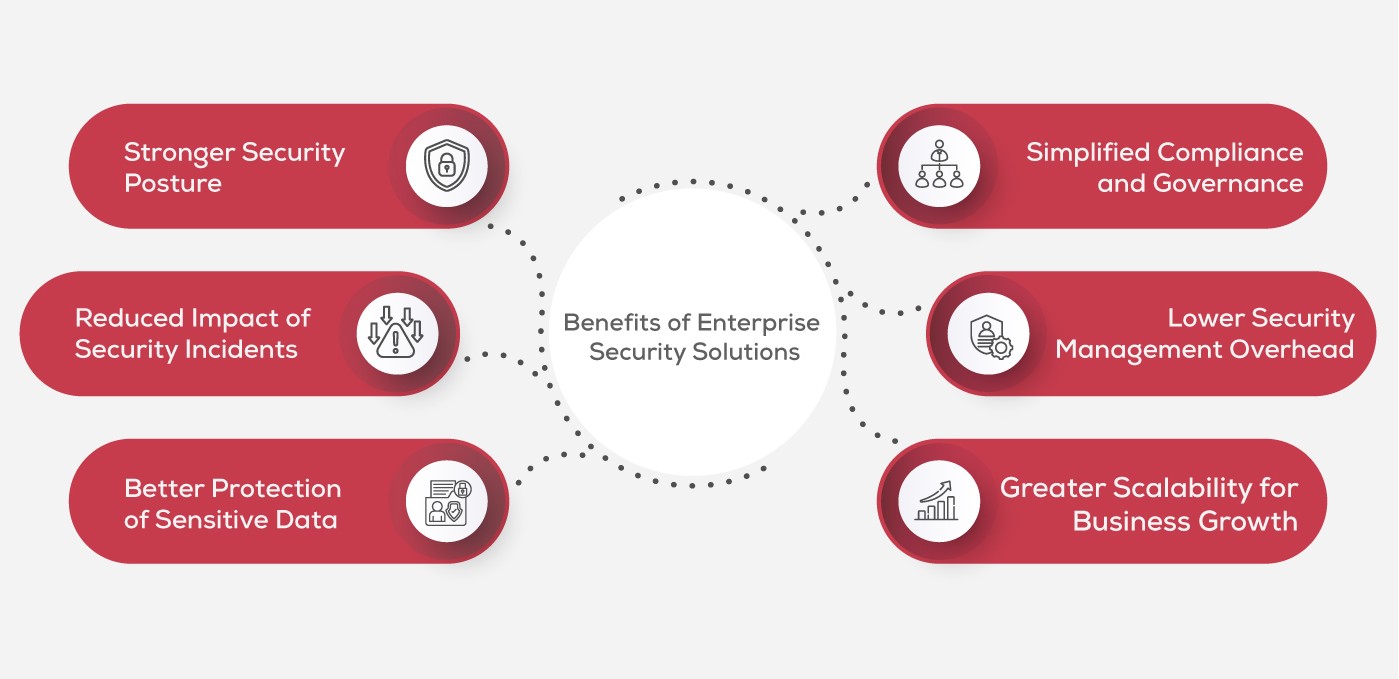
Beyond protecting against cyber threats, enterprise security solutions deliver lasting value across the organization. The following are some of the key benefits businesses can expect.
- Stronger Security Posture
A comprehensive security strategy helps organizations safeguard users, applications, devices, and data through consistent security controls. This creates a more secure IT environment and reduces exposure to evolving cyber risks.
- Reduced Impact of Security Incidents
Early threat identification and coordinated response help contain security incidents before they escalate. As a result, organizations can minimize operational disruptions, reduce recovery efforts, and maintain uninterrupted business operations.
- Better Protection of Sensitive Data
Security controls help prevent unauthorized access to confidential business and customer information. This lowers the risk of data breaches while protecting intellectual property, financial information, and other sensitive assets.
- Simplified Compliance and Governance
Centralized security policies, monitoring, and reporting make it easier to comply with regulatory requirements and industry standards. Streamlined governance also improves accountability and simplifies audit preparation.
- Lower Security Management Overhead
Automation and centralized administration reduce the time and effort required to manage day-to-day security tasks. This improves operational efficiency and enables IT teams to focus on strategic priorities.
- Greater Scalability for Business Growth
Enterprise security solutions are designed to grow with the organization, supporting new users, devices, applications, and locations without requiring major changes to the existing security environment.
How to Choose the Ideal Enterprise Security Solution
Selecting the right enterprise cybersecurity solution requires evaluating how well it aligns with your organization's security requirements, IT environment, and future growth. The following factors can help guide the selection process.
1. Scalability for Business Growth
Choose a solution that can scale with your organization's growth without adding unnecessary complexity. For smaller businesses that lack a dedicated Security Operations Center, features such as centralized management, automated response, and flexible licensing help simplify security operations.
2. Platform Compatibility and Integration
Enterprise security solutions should integrate seamlessly with your existing IT ecosystem. Support for API integrations, SIEM platforms, firewalls, and vulnerability management tools enables better visibility, streamlined workflows, and centralized threat management.
3. AI-Driven Threat Detection
Modern security platforms should leverage Artificial Intelligence and Machine Learning to identify evolving attack patterns and suspicious behavior. Combined with real-time threat intelligence, these capabilities improve intrusion detection and accelerate incident response.
4. Ease of Management and Support
A digital security platform should be intuitive to deploy, manage, and maintain. Reliable technical support, regular updates, and comprehensive documentation help security teams maximize the platform's effectiveness.
5. Cost and Long-Term Value
Look beyond the initial purchase price by evaluating the Total Cost of Ownership (TCO), including licensing, implementation, maintenance, and training. The right solution should strengthen cyber risk management while delivering long-term operational value and scalability.
Future Trends in Enterprise Security Solutions
Emerging technologies and evolving cyber threats are reshaping the future of enterprise security. The following trends are expected to influence how organizations protect their digital environments in the years ahead:
Identity-first Security
Identity-First Security extends Zero Trust by placing digital identities at the center of access decisions. Instead of relying on network boundaries, it continuously verifies human and non-human identities and applies context-aware access policies across cloud, on-premises, and hybrid environments.
Passwordless authentication
Passwordless Authentication allows users to access systems without relying on passwords or security questions. Instead, it uses alternatives such as biometrics, security keys, passkeys, smart cards, or hardware tokens for verification. When combined with Multi-Factor Authentication (MFA) and Single Sign-On (SSO), it improves user experience, strengthens security, and reduces the complexity of IT management.
Quantum-resilient encryption
Quantum-resilient encryption (also known as post-quantum cryptography) is designed to protect sensitive data against future attacks from quantum computers. As quantum computing advances, organizations are beginning to adopt cryptographic algorithms that can withstand quantum-enabled attacks while ensuring long-term data security.
Security for autonomous AI-driven systems
As organizations increasingly deploy autonomous AI agents, securing these systems has become a growing priority. Unlike traditional applications, AI-driven systems can make decisions, access enterprise resources, and interact with other services autonomously. Combining continuous monitoring with security automation, identity controls, and governance enables organizations to detect anomalies, enforce security policies, and ensure AI systems operate securely and responsibly
Conclusion
Enterprise security now depends on how well organizations can connect their systems, respond to change, and stay adaptable as new risks emerge. Strength comes from building a setup that is integrated, scalable, and easy to manage over time.
With Inspirisys Enterprise Security Solutions, organizations can bring together key capabilities into a unified framework that supports both current needs and future growth. By combining integration, visibility, and flexibility, Inspirisys helps businesses stay prepared and move forward with confidence in a constantly evolving security landscape.
Frequently Asked Questions
1. How often should enterprise security systems be updated?
Security systems should be updated continuously, not just periodically. Regular patching, software updates, and policy reviews help address newly discovered vulnerabilities and keep cyber defenses aligned with evolving threats.
2. Can enterprise security solutions be customized for different industries?
Yes, most enterprise security solutions can be tailored to specific industry requirements. Sectors like healthcare, finance, and government often need customized configurations to meet regulatory and operational needs.
3. How long does it take to implement an enterprise security solution?
Implementation timelines vary depending on the size of the organization, system complexity, and integration requirements. It can range from a few weeks for smaller setups to several months for large-scale deployments.
4. What role do employees play in enterprise security?
Employees are a crucial part of enterprise security. Even the most advanced systems can be compromised through human error, so regular training and awareness programs are essential to reduce risks like phishing or accidental data exposure.
5. Should organizations choose all-in-one platforms or multiple specialized tools?
This depends on business needs. All-in-one platforms offer simplicity and easier management, while specialized tools may provide deeper capabilities in specific areas. Many organizations use a combination of both for balanced coverage.