
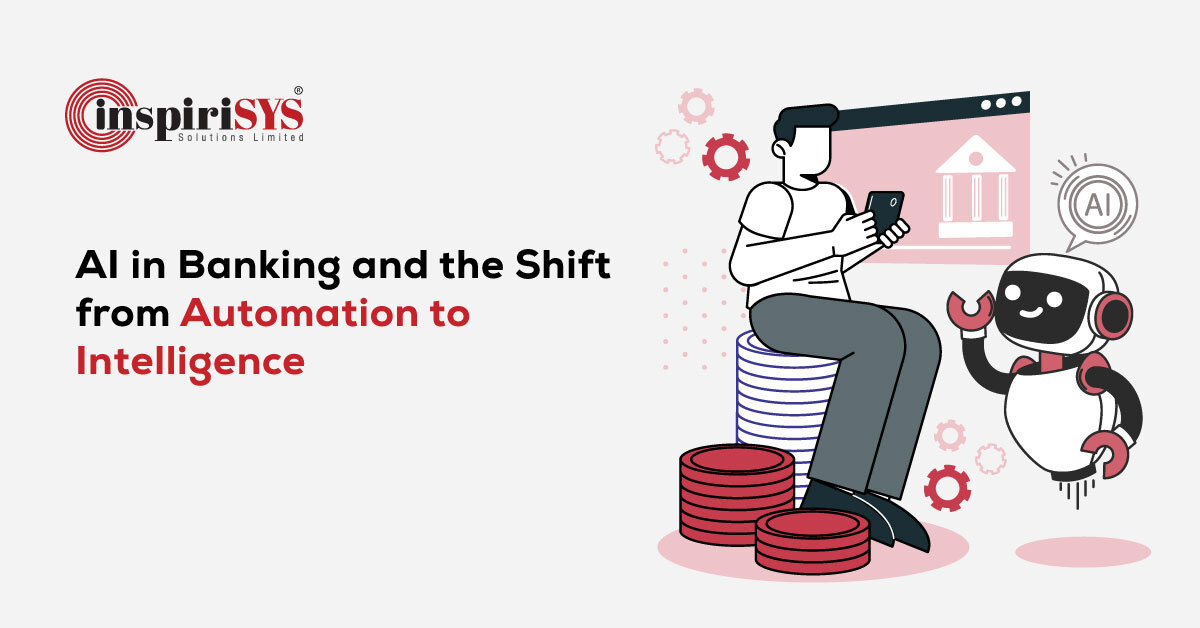
For years, banks have turned to technology mainly to do the same things faster: process transactions, cut costs, reduce friction. But now, Artificial intelligence has changed that equation. The real question isn't how fast AI can make existing processes, but what happens when a bank's technology stops merely executing instructions and starts helping shape judgment calls such as which loan to approve, which risk to flag, which customer to prioritize. How banks respond to this question will shape their ability to remain relevant as the financial landscape grows more complex.
The shift from automation to intelligence signals a change in what banks can expect from AI. It opens up possibilities that go beyond streamlining existing operations, prompting financial institutions to reconsider how they use AI to create value and prepare for the next phase of banking.
Key Shifts in AI-Powered Banking
The following sections examine distinct dimensions of AI adoption in banking, from changes in day-to-day processes to the broader considerations involved in putting these capabilities into practice. Together, they provide a closer look at how this transition is taking shape across the sector.
Rule-Based Automation to Intelligent Decision-Making
Traditional banking automation has primarily focused on executing predefined instructions, such as verifying documents and routing customer requests. While these systems help reduce manual effort and processing time, they generally operate within established rules and workflows. AI is extending these capabilities by enabling banks to analyse larger volumes of information, recognise patterns and support decisions in situations that require more than routine task execution.
This transition is evident in areas such as customer verification, credit assessment and customer service. For instance, automated credit processing can collect application details and apply set eligibility criteria. AI-assisted assessment can go further by analysing relevant financial information and identifying patterns that may help credit officers evaluate an application. Similarly, AI-powered service tools can help employees retrieve relevant customer data and suggested responses, allowing them to focus on enquiries that require additional judgment.
Isolated Applications to AI Across the Banking Value Chain
AI is being applied across the banking value chain, from customer acquisition and onboarding to lending, relationship management, servicing and compliance. Current applications include predictive lead scoring, automated document verification, AI-assisted credit scoring, customer insight dashboards and automated reconciliation. These tools are helping banks bring AI into different areas of their operations rather than limiting it to individual tasks.
The next phase is about connecting these applications to create more coordinated banking experiences. For instance, insights gathered during customer interactions could inform subsequent engagement, while integrated workflows could reduce handoffs between departments. Emerging capabilities such as AI-guided customer journeys and continuous compliance monitoring point towards a more connected banking model, where information and processes work together across the customer lifecycle.
Operational Efficiency to Measurable Business Value
AI's contribution to banking is evolving from improving how quickly work gets done to influencing the outcomes of banking activities. Beyond reducing processing delays and manual workloads, AI can help lending teams make more informed assessments, enable relationship managers to respond to customers' changing needs and give risk teams earlier visibility into potential concerns. These capabilities can affect the quality of services, customer engagement and financial decisions, not just operational output.
This wider impact also brings a different cost equation. Developing and maintaining AI capabilities involves sustained investment in computing resources, data infrastructure, security, governance and employee expertise. As a result, the value of AI is increasingly tied to the results it produces over time, relative to the resources needed to support it. The number of tools deployed or processes automated alone does not capture that value; the real measure is how AI contributes to the bank's broader financial and operational performance.
Responsible AI and Governance
As AI takes on a broader role in banking, ensuring that its use is fair, transparent and accountable becomes increasingly important. AI-driven decisions can influence loan approvals, customer eligibility and fraud investigations, making it essential for banks to understand how these systems operate and how their outputs affect customers. Clear accountability, explainable decisions and safeguards against bias are therefore important to building trust. Strong data governance, including controls over data access, usage and storage, also helps protect customer information and address data sovereignty concerns.
AI is also changing how banks manage regulatory compliance. Applications such as automated regulatory reporting, reconciliation and compliance monitoring can help financial institutions track obligations, identify gaps and maintain audit trails. Emerging AI capabilities could further support real-time monitoring and help teams assess the impact of regulatory changes.

In India, the RBI’s FREE-AI framework provides guidance for responsible AI adoption in the financial sector. Its seven principles cover trust, people first, innovation, fairness, accountability, explainability, and safety and sustainability. These principles highlight the need to balance AI innovation with effective governance and customer protection.
AI Adoption to Sustainable Scaling
As banks expand their use of AI, the focus is extending beyond deploying new capabilities to managing the resources needed to sustain them. Advanced AI models require substantial computing power, data storage and processing capacity, increasing the energy and water demands of the data centres that support them. This brings the environmental impact of AI infrastructure into sharper focus.
For banks, sustainability is becoming part of the wider conversation around AI strategy. Beyond managing the footprint of their own technology operations, banks can influence how digital infrastructure is financed and developed. This broadens the scope of responsible AI adoption to include not only how AI is used, but also the environmental implications of scaling it.
The Future of Banking
AI is taking banking beyond faster processes towards smarter decisions, more personalised services and proactive risk management. From real-time fraud detection and intelligent compliance monitoring to AI-driven financial advice and emerging AI agents, the next phase promises to reshape how financial services are delivered.
But greater intelligence also brings greater responsibility. The real measure of progress will be how effectively banks combine AI capabilities with human oversight, accountability and customer trust. The future of banking will not be defined by how much work AI can automate, but by how intelligently it can help banks act.
Frequently Asked Questions
1. How can banks use AI to improve customer onboarding, servicing and engagement?
AI can help banks make onboarding faster through document processing, identity checks and application support. During servicing, AI-powered assistants can answer routine questions and help employees find relevant information. Banks can also use customer data and changing financial behaviour to offer more relevant services and recommendations, while respecting consent and privacy.
2. How do generative AI and agentic AI shape the future of banking customer experience?
Generative AI can support conversational services, summarise customer interactions and help employees access useful information. Agentic AI can coordinate multi-step tasks across connected systems, within defined permissions and with appropriate human oversight. These capabilities can make customer journeys more responsive, while requiring clear safeguards for data use and decision-making.
3. Is generative AI safe to use in banking?
Generative AI can be used in banking when supported by strong security, data protection, governance and human oversight. Banks need to check the accuracy of AI-generated outputs, protect sensitive customer information and ensure that each use case meets applicable regulations. Its safety depends on how it is designed, deployed and monitored.
4. What are the main challenges of using AI in banking?
The main challenges include protecting customer data, reducing bias, explaining AI-driven decisions and meeting regulatory requirements. For example, banks need to ensure that AI-supported loan assessments do not lead to unfair outcomes and that decisions can be properly reviewed. They also need clear accountability and ongoing monitoring as regulations and AI systems evolve.