
For many enterprises, critical business information remains trapped in fragmented legacy silos. This compounding technical debt limits operational efficiency, keeps IT teams focused on reactive firefighting, and reduces the ROI of digital investments. As legacy environments become harder to maintain, data modernization is becoming essential to improving current performance and supporting future growth.
Achieving this requires a deliberate, business-aligned data migration strategy. When migration is approached as part of broader data modernization and business transformation, organizations can address legacy constraints and build a modern, scalable data foundation. This article examines the costs of delaying modernization and outlines five strategic priorities for getting data migration right.
The Business Risks of Delaying Modernization
Maintaining the status quo carries growing costs, from rising technical debt to fragmented data and compounding operational risk. To understand the true cost of delay, leaders must look at how legacy data acts as a double-edged sword simultaneously draining current operational efficiency and blocking future revenue growth.
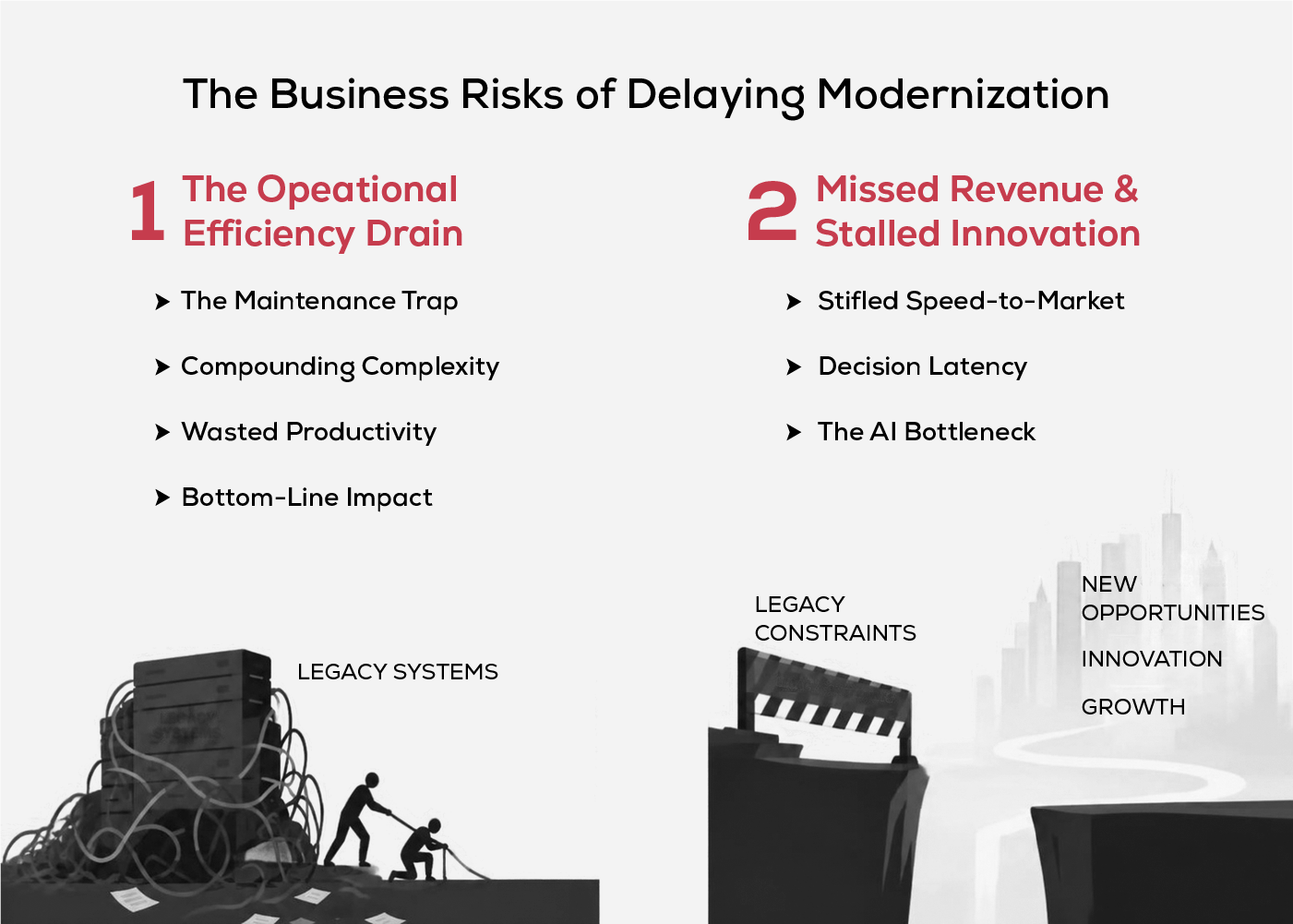
1. The Operational Efficiency Drain (The Cost of the Status Quo)
Legacy environments force organizations to dedicate disproportionate resources just to keep outdated systems running.
- The Maintenance Trap: Organizations waste critical budget and talent maintaining outdated applications, managing complex integrations, and working around rigid architectural limitations.
- Compounding Complexity: Delaying transformation adds new technical dependencies and constraints over time, which continually inflates the cost, risk, and complexity of any future migration.
- Wasted Productivity: Legacy infrastructure makes data incredibly difficult to discover, integrate, and prepare. Instead of building new capabilities, teams spend their time manually reconciling multiple versions of the same data, resolving inconsistent calculations, and navigating disconnected reporting processes.
- Bottom-Line Impact: This operational friction ultimately degrades forecasting accuracy and leads to inefficient resource allocation throughout the enterprise.
2. Missed Revenue & Stalled Innovation (The Cost of Lost Opportunity)
While legacy systems drain your current resources, they also actively block your organization’s ability to capture new market opportunities and scale modern technology.
- Stifled Speed-to-Market: When technology environments hinder integration and development speed, they directly impair the organization’s ability to execute strategy, respond to market changes, and pursue new growth opportunities.
- Decision Latency: Because fragmented data undermines trust in business insights, decision-making slows. Leaders are forced to rely on slow, assumption-based planning rather than timely, evidence-based intelligence, directly hurting customer responsiveness and overall competitiveness.
- The AI Bottleneck: Enterprise AI depends entirely on high-quality, well-governed data. Legacy environments struggle to support the real-time processing, distributed models, and interoperability that AI requires, creating a massive barrier that prevents organizations from moving AI from experimentation to enterprise-wide adoption.
Strategic Priorities for Data Migration
Strategic data migration is shaped by the decisions made before, during, and after data is moved. Leaders must treat migration as a business transformation initiative, not simply a technology exercise. The priority is to make deliberate choices around migration strategy, data readiness, architecture, accountability, and future capabilities to ensure the investment delivers lasting business value.
1. Choose the Migration Approach Based on Business Priorities
Do not select a migration model based solely on technical feasibility or speed. Determine the approach based on business criticality, operational dependencies, risk tolerance, transformation objectives, and the required timeline.
A large-scale migration may accelerate transformation but can increase disruption and execution risk. A phased or incremental approach can provide greater control and continuity but may extend the transition period and require the organization to operate across legacy and modern environments for longer.
The right approach must balance speed, business continuity, risk, and transformation value.
2. Establish Data Readiness Before Moving Data
Do not migrate data until you understand what you are moving, why it matters, where it resides, and what depends on it.
Assess data quality, structure, ownership and usage before migration begins. Identify duplicate, obsolete, inconsistent, or incomplete data and determine what should be cleansed, consolidated, archived, or retired rather than transferred.
Establish governance and quality standards before migration so that the new environment does not simply inherit the weaknesses of the old one. Moving poor-quality or redundant data into a modern environment only increases the cost of managing it later.
3. Design for the Future, Not for Replication
Do not recreate the legacy environment in a new technology stack. Replicating existing architectures may simplify the initial migration, but it can lock organizations into the same inefficiencies while adding the cost of the new environment.
Use migration as an opportunity to simplify data flows, eliminate unnecessary dependencies, improve interoperability, and establish secure access across the enterprise. Design the target architecture around the capabilities the business needs next, including scalability, real-time data access, advanced analytics, AI workloads, and integration with evolving applications and platforms.
The objective is not to reproduce what exists. It is to build the data foundation the business will need next.
4. Make Business and IT Accountable for Data Validation
Do not leave validation to IT alone. Technology teams can confirm that data has been transferred correctly, but business teams must confirm that the migrated data supports the processes and decisions that depend on it.
Establish clear ownership between IT and business functions before migration. IT teams should validate data integrity, system performance, integrations, access controls, and technical dependencies. Business and operational teams should validate critical records, reports, workflows, calculations, and business outcomes against the source environment.
Require business owners to sign off on critical datasets and processes before migration waves are considered complete. This turns validation from a technical checkpoint into business assurance and gives leadership a clear basis for approving the transition.
5. Build for Continuous Innovation, Not One-Time Modernization
Treat migration as the foundation for what comes next, rather than the endpoint of a technology program.
Build the modern data environment to support new applications, analytics use cases, AI initiatives, changing regulatory requirements, and evolving business models. Establish the scalability and interoperability required to introduce new capabilities without repeatedly redesigning the underlying data environment.
Measure the success of migration not only by whether data moved successfully, but by whether the organization can access, trust, integrate, analyze, and act on that data more effectively than before.
A successful migration should therefore leave the organization with more than a modern technology environment.
The Business Outcomes Enabled by Modern Data
The value of modernization is measured by what the business can achieve with its data. A modern data foundation enables faster decisions, more responsive operations, scalable innovation, and greater capacity for growth.
Faster, More Confident Decisions
Leaders gain timely access to consistent business information, reducing the time spent reconciling reports and validating data. This enables faster decisions across functions and greater confidence in acting on business insights.
Greater Operational Agility
Teams can respond faster to changing customer needs, market conditions, and business priorities when critical information is readily available. This shortens the gap between identifying a change and acting on it.
Scalable Analytics and AI
Modern data environments provide the foundation to move analytics and AI from individual use cases to broader business adoption, enabling organizations to create value from data between functions and applications.
Lower Cost of Change
A modernized data environment makes it easier to introduce new applications, connect new data sources, and support evolving business requirements without repeatedly working around legacy constraints.
Greater Capacity for Growth
With fewer data-related constraints, organizations can pursue new products, services, business models, and technology initiatives with greater flexibility and speed.
The Imperative for Business Leaders
Data migration and modernization are ultimately business decisions, not simply technology exercises. The choices leaders make about what to migrate, what to modernize, and where to prioritize investment will shape how effectively the organization can use its data to support business priorities.
The objective is not simply to move away from legacy environments, but to build a modern, trusted, and scalable data foundation that can evolve with the business. When leaders approach migration as part of broader modernization, they can improve agility, support innovation, and create greater capacity for growth.
Frequently Asked Questions
1. What are the key considerations for unifying enterprise data?
Unifying enterprise data requires more than implementing a technology solution. Organizations should address organizational and cultural change, build the right data skills, avoid technical and integration pitfalls, and ensure data privacy, security, and regulatory compliance.
2. What are the common data modernization mistakes organizations should avoid?
Organizations should avoid treating data modernization as a simple technology upgrade or data migration exercise. Common mistakes include moving poor-quality or redundant data, replicating legacy architectures, overlooking data dependencies, and treating modernization as an IT-only initiative. It is also important to avoid designing only for current requirements or treating modernization as a one-time project.
3. What is the difference between data migration, database migration, and data center migration?
Data migration involves moving data between systems, platforms, or environments, while database migration specifically involves moving a database and may include changes to its structure or technology. Data center migration is broader and involves moving IT infrastructure and workloads, which can include servers, storage, applications, networks, and databases. These activities can form part of the same modernization initiative but address different scopes.