
Modern IT environments depend on cloud infrastructure to support business applications, digital services and data-driven operations across increasingly diverse technology ecosystems. As organizations continue to modernize their IT landscape, understanding the foundation that powers these environments has become an important part of making informed infrastructure decisions.
A clear understanding of cloud infrastructure helps organizations evaluate the technologies that support enterprise workloads and operational requirements. This article explores the different types of cloud infrastructure, its core requirements, and the role it plays in building reliable and efficient IT environments.
What is Cloud Infrastructure
Cloud infrastructure is the underlying framework of physical and virtual resources that enables cloud computing environments. It consists of the computing, storage, networking, virtualization and management resources required to host applications, process data and support enterprise workloads. These resources are provisioned as an integrated infrastructure that can be deployed across environments.
The structure of these resources is defined by cloud architecture, which determines how the infrastructure is designed to support specific business and workload needs. While deployment models may differ, every cloud environment relies on a common set of components that work together to enable cloud operations.
Core Components of a Cloud Infrastructure
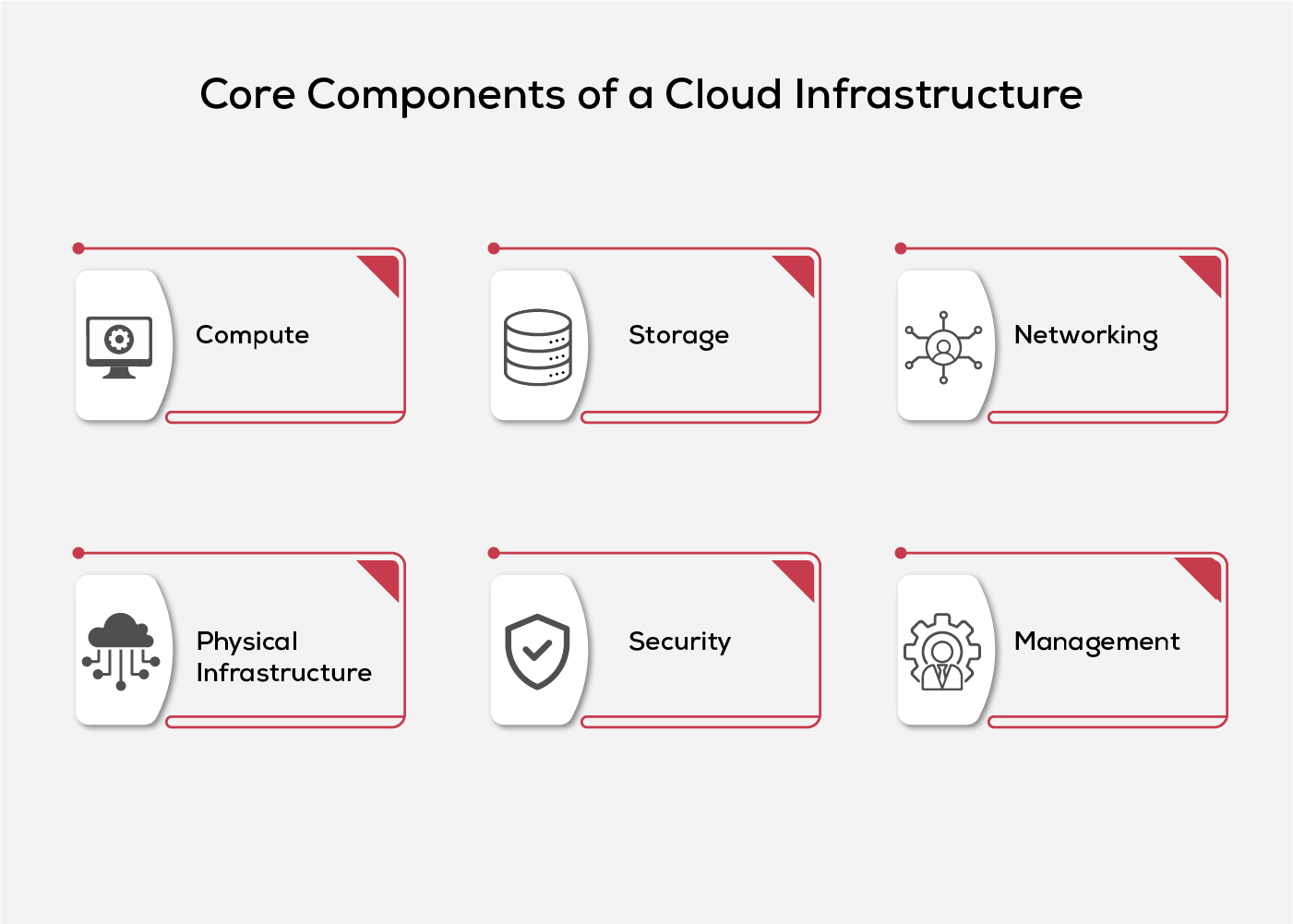
Cloud infrastructure consists of several interconnected elements that work together to support computing environments. Each component performs a specific function, enabling applications, data and services to operate as part of an integrated cloud ecosystem.
Compute
The compute layer provides the processing resources required to run applications and workloads. It relies on virtualization technology to abstract physical hardware into virtualized computing resources, including virtual machines, containers and other execution environments that support diverse workloads.
Storage
Cloud storage enables data to be stored, accessed and managed across cloud environments. Depending on application requirements, storage can be provisioned for structured or unstructured data, files, objects or block storage while supporting persistent data availability.
Networking
Network infrastructure connects computing resources, storage systems, users and applications within the cloud environment. It manages communication between workloads and facilitates data transfer across cloud, on-premises and hybrid environments.
Physical Infrastructure
Although cloud services are delivered virtually, they are supported by physical infrastructure housed in geographically distributed data centers. Servers, storage devices, networking equipmen and other hardware provide the underlying foundation on which cloud environments operate.
Security
Security mechanisms help protect cloud infrastructure, applications and data through controls such as Identity and Access Management, encryption, authentication, network security and continuous monitoring. These measures work together to safeguard cloud environments against unauthorized access and evolving threats.
Management
Cloud infrastructure is administered through centralized management tools that enable administrators to provision resources, monitor workloads, configure services and maintain the overall cloud environment throughout its lifecycle.
Types of Cloud Infrastructure
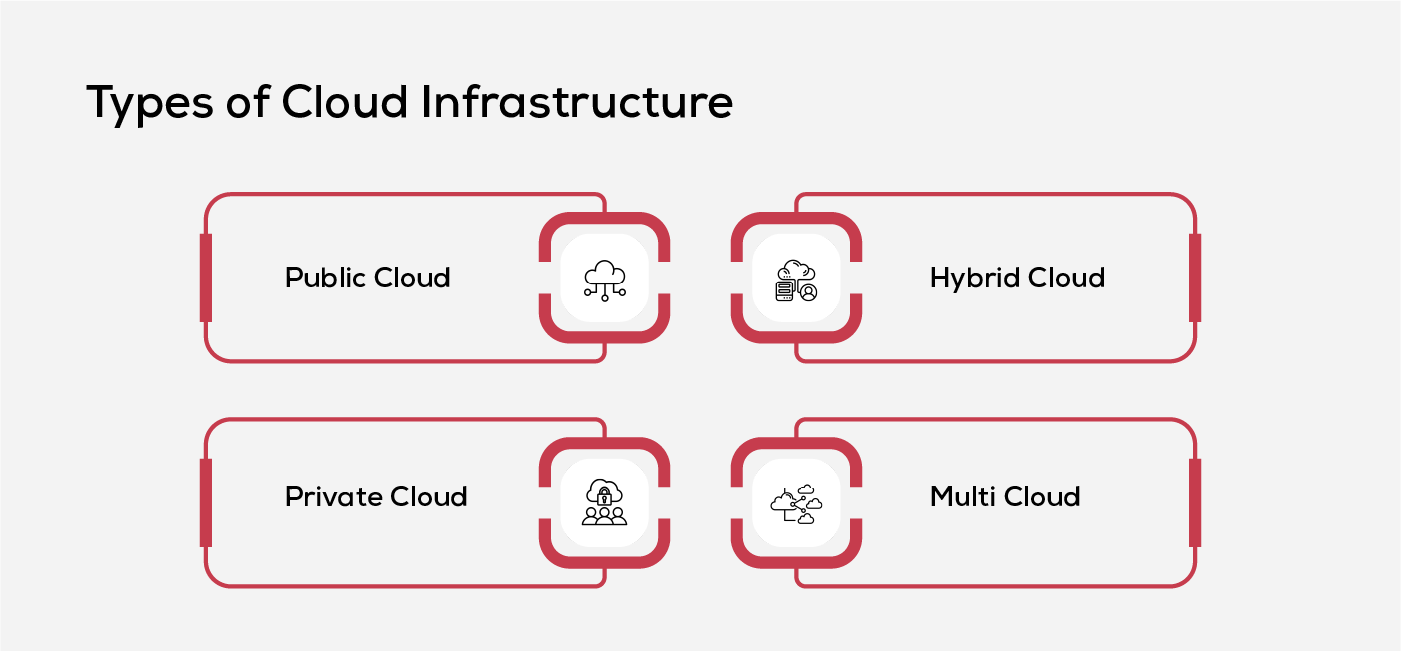
Organizations can implement cloud infrastructure in different ways based on how computing resources are deployed, owned and managed. These cloud deployment models define the environment in which cloud resources are hosted and delivered. The four primary cloud types are public cloud, private cloud, hybrid cloud and multi cloud.
Public Cloud
A public cloud is owned and operated by a third-party cloud service provider that delivers computing resources over the internet. The provider is responsible for managing the underlying infrastructure, while customers provision and use cloud resources based on their requirements.
Private Cloud
A private cloud is dedicated to a single organization, with cloud resources reserved exclusively for its use. It can be deployed within an organization's own data center or hosted by a third-party provider, while maintaining an isolated cloud environment.
Hybrid Cloud
A hybrid cloud integrates public and private cloud environments, enabling applications, workloads, and data to operate across both through a connected infrastructure. This approach allows organizations to maintain a unified cloud environment while utilizing multiple deployment environments.
Multi Cloud
A multi cloud environment involves the use of cloud services from two or more cloud providers. Organizations distribute applications or workloads across multiple cloud platforms based on their operational, technical, or business requirements.
Cloud Infrastructure Requirements for Modern Enterprises
Implementing cloud infrastructure requires careful planning to ensure it aligns with business objectives, application demands, and operational priorities. Defining clear cloud requirements before deployment helps organizations build an environment that supports current workloads while accommodating future technology and business needs.
Infrastructure Planning and Design
A well-defined cloud infrastructure design establishes how computing resources, applications and data will be organized within the cloud environment. The design should consider workload characteristics, capacity planning, availability objectives, integration requirements and future expansion.
Service and Workload Alignment
Selecting appropriate infrastructure services requires evaluating the computing, storage and networking resources needed to support different business applications. Workload assessment helps determine resource allocation, performance expectations, and operational dependencies before implementation.
Provider Evaluation
Choosing suitable cloud providers involves assessing factors such as service capabilities, geographic availability, compliance support, Service-Level Agreements (SLAs) and long-term platform compatibility. The selected provider should align with both technical requirements and organizational objectives.
Scalability and Resilience Planning
Modern IT environments should be designed as scalable cloud systems that can accommodate changing application demands without extensive infrastructure redesign. Planning for capacity growth, workload distribution and service continuity helps ensure the infrastructure remains effective as business requirements evolve.
Governance and Operational Readiness
Successful cloud adoption(hyperlink with cloud adoption blog) also depends on establishing governance policies, operational processes, access controls, monitoring practices and lifecycle management procedures. These measures provide the operational framework needed to manage cloud infrastructure consistently throughout its lifecycle.
Benefits of Cloud Infrastructure for Businesses
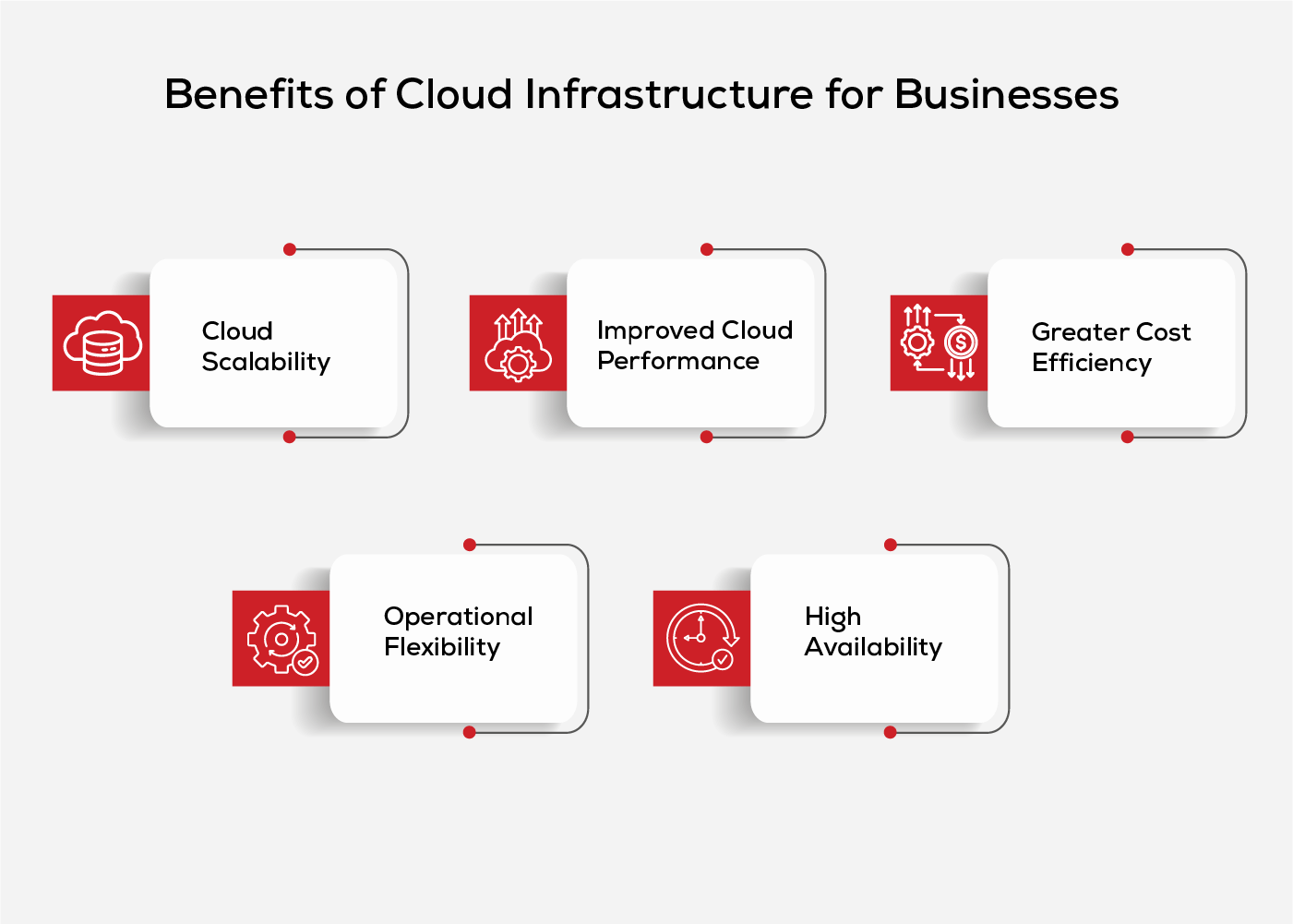
A well-designed cloud infrastructure strengthens IT operations by enabling organizations to support evolving workloads, improve resource utilization and maintain dependable service delivery. Key benefits include:
Cloud Scalability
Cloud scalability enables organizations to adjust infrastructure resources in response to changing workload demands. Supported by elastic computing, it allows resources to be provisioned or released as needed, ensuring applications continue to operate efficiently.
Improved Cloud Performance
Cloud infrastructure enables resources to be allocated according to workload requirements, helping optimize cloud performance across business applications while minimizing resource bottlenecks.
Greater Cost Efficiency
By aligning infrastructure consumption with operational requirements, cloud infrastructure supports cost efficiency cloud initiatives and helps organizations optimize IT spending without unnecessary resource overprovisioning.
Operational Flexibility
Cloud infrastructure allows organizations to provision, configure and adapt IT resources more efficiently as business and application requirements evolve. This enables faster response to changing operational needs while maintaining consistent service delivery.
High Availability
Cloud infrastructure can be designed to support high availability cloud environments through resilient infrastructure architectures. This helps minimize service interruptions and maintain application availability during planned or unexpected events.

Top 5 Cloud Infrastructure Providers
Cloud infrastructure providers have evolved beyond offering virtual servers and storage. Today, they provide complete ecosystems that support application development, data management, networking, automation and AI-driven workloads. The right provider depends on factors such as workload requirements, regulatory obligations, existing technology investments and long-term cloud strategy.
The following providers continue to play a significant role in shaping enterprise cloud infrastructure worldwide.
- Microsoft Azure
- Amazon Web Services (AWS)
- Google Cloud Platform (GCP)
- Oracle Cloud Infrastructure (OCI)
- IBM Cloud
Conclusion
As organizations continue to embrace digital transformation, cloud infrastructure remains a foundational element for supporting emerging technologies, distributed applications, and data-intensive operations. A thorough understanding of cloud infrastructure components, deployment options, and planning considerations enables organizations to make informed decisions that support both current operational needs and future technology initiatives.
Inspirisys brings deep expertise across cloud technologies, helping enterprises navigate complex infrastructure environments with confidence. By combining technical excellence, industry experience, and a consultative approach, we help organizations establish robust cloud foundations that support innovation, governance, and long-term operational success.
Frequently Asked Questions
1. Is cloud infrastructure the same as cloud computing?
No. Cloud infrastructure is the underlying technology that enables cloud services, while cloud computing is the delivery of computing resources and applications over the internet. In simple terms, cloud infrastructure powers cloud computing.
2. What is cloud architecture?
Cloud architecture is the blueprint for designing and organizing cloud environments. It defines how cloud resources and services are structured, connected, and managed to support application performance and reliability.
3. What are the different cloud service models?
Cloud services are commonly delivered through three service models: Infrastructure as a Service (IaaS), Platform as a Service (PaaS), and Software as a Service (SaaS). An IaaS cloud model provides on-demand infrastructure resources, PaaS offers a managed platform for application development, and SaaS delivers ready-to-use software applications over the internet.
4. How is cloud infrastructure managed and optimized?
Cloud infrastructure management involves monitoring, provisioning, securing, and maintaining cloud resources throughout their lifecycle. Optimization focuses on improving resource utilization, performance, scalability, and cost efficiency through continuous monitoring, automation, and capacity planning.
5. How do on-premises and cloud infrastructure differ?
On-premises infrastructure is owned, managed, and maintained by the organization, while cloud infrastructure is delivered through a cloud provider's platform on a consumption-based model. The choice depends on factors such as business requirements, regulatory obligations, budget and operational priorities.