
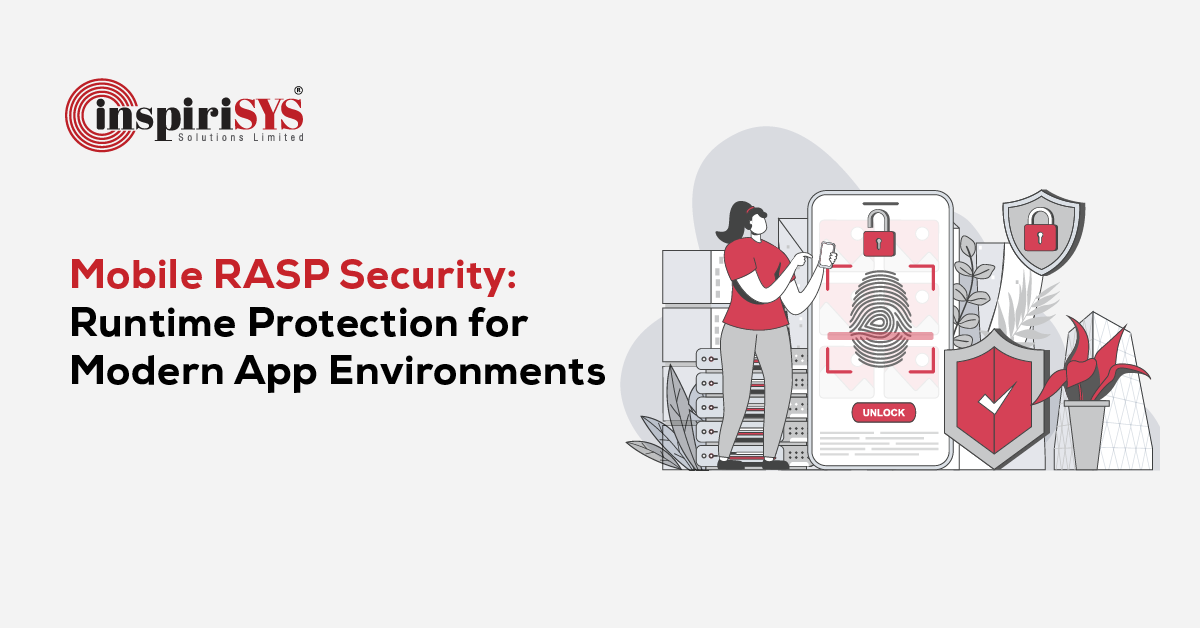
Quick Summary: Mobile application security has become a critical priority as businesses increasingly rely on apps to deliver services, handle transactions, and manage sensitive user data. The growing adoption of mobile platforms has widened the attack surface, exposing applications to risks such as code tampering, reverse engineering, API abuse, and runtime manipulation. Conventional security layers like firewalls, endpoint protection, and static code scans offer limited visibility into threats that occur during an app’s execution.
Runtime Application Self-Protection (RASP) addresses this gap by embedding security into the application runtime. It enables applications to detect and respond to attacks in real time, based on how the code behaves and how the system interacts with it.
This article explores how RASP works, what makes it relevant for mobile environments, the core features it offers, deployment considerations, and how it complements existing security strategies.
What is RASP?
Runtime Application Self-Protection (RASP) is a security technology that operates from within the application to monitor its behaviour and protect it during execution. Unlike perimeter-based tools that filter traffic or detect vulnerabilities externally, RASP is integrated into the application’s runtime environment and responds to threats based on real-time data.
The core principle behind RASP is to make the application capable of recognizing and neutralizing threats as they occur, without relying on external monitoring systems. It does this by instrumenting the application code or runtime libraries, allowing it to inspect inputs, control execution flows, and block malicious activity immediately.
By working within the application context, RASP can distinguish between legitimate and suspicious behavior more accurately than static or network-layer defenses. This level of insight allows it to detect advanced threats such as injection attacks, unauthorized code execution, and runtime data manipulation that other tools might miss.
Key Features of an Effective RASP Solution for Mobile Apps
A robust RASP solution designed for mobile environments includes the following built-in capabilities:
1. Obfuscated Runtime Checks
Security checks are embedded in the application in a fully obfuscated manner, making it difficult for attackers to locate or disable protection logic through static analysis or reverse engineering.
2. Polymorphic Injection Engine
Each build of the application dynamically injects RASP logic into different code locations. By using polymorphism, the app changes its behavior across versions, making it harder for attackers to reuse the same exploit or launch scalable attacks.
3. Adaptive Instrumentation
RASP automatically evaluates function usage during runtime and prioritizes instrumentation accordingly. This model ensures that security coverage adapts based on behavioral risk, with minimal impact on performance.
4. Developer-Controlled Tuning
The solution offers configurable tuning options that allow developers to adjust the depth, frequency, and sensitivity of security checks while balancing protection strength and performance requirements.
5. Real-Time Threat Response
Built-in monitoring continuously analyzes application behavior and intervenes immediately when a threat is detected. Actions may include blocking execution, alerting the user, or returning deceptive responses to the attacker.
How RASP Works?
RASP functions by continuously observing the application’s execution to detect anomalies, unauthorized access, or malicious inputs. It inspects traffic, monitors internal behavior, and analyzes how requests interact with the application logic in real time.
Depending on its configuration, RASP operates in one of two modes:
- Diagnostic mode logs unusual activity and alerts the user or system administrator.
- Protection mode actively intercepts and blocks potential threats, such as halting execution if code injection is suspected.
RASP systems typically respond in one of the following ways:
- Alerting the end-user of suspicious behavior.
- Terminating the application process when a severe threat is identified.
- Providing misleading or false data to confuse the attacker and prevent further misuse.
By analyzing runtime context, data flows, and execution paths, RASP can distinguish between legitimate operations and actual threats with high accuracy, minimizing false positives. It also protects application data across its lifecycle, from input to deletion, ensuring resilience even in complex deployment models like BYOD.
This capability is especially valuable in compliance-heavy environments, where unreadable or encrypted stolen data can exempt organizations from breach reporting requirements under certain regulations.
Types of Mobile App Threats
Effective mobile application security must address a range of dynamic threats that can compromise app integrity, user data, and backend systems. Below are some of the most common threats that RASP is designed to detect and mitigate:
1. Debugger Exploitation
Debuggers, typically used for troubleshooting, can be misused by attackers to gain visibility into an app’s internal processes. By monitoring memory, registers, and runtime behavior, attackers can inject code, extract sensitive data, or bypass controls.
2. Emulators and Simulators
Emulators mimic mobile devices and allow attackers to run apps in controlled environments. They enable deep inspection, OS-level manipulation, and the circumvention of hardware-bound security features, making it easier to analyze and exploit app behavior.
3. App Repackaging
Attackers often modify and repackage legitimate apps to insert malicious payloads. These counterfeit apps, once distributed through unofficial channels, can harvest credentials, spy on user activity, or inject malware into enterprise environments.
4. Function or Method Hooking
Hooking tools intercept and alter method calls at runtime, allowing attackers to manipulate app logic without changing the source code. This technique is used to bypass authentication, extract encryption keys, or reroute in-app transactions.
5. Dynamic Binary Instrumentation (DBI)
DBI frameworks inject instructions into a running app to observe or modify behavior. While useful for testing, attackers use DBI to override security logic, alter decision paths, or gain unauthorized access to protected functions.
6. Jailbreaking and Rooting
On jailbroken (iOS) or rooted (Android) devices, attackers gain unrestricted access to system files and configurations. This elevated control can be used to disable app protections, install malicious modules, or perform invasive data exfiltration.
Static Security vs. Runtime Protection in Mobile Applications
A layered approach to mobile application security is essential for covering the full spectrum of attack surfaces. Two major components of this approach are static security and runtime protection, each addressing different phases of the app lifecycle and different categories of threats.
Static security refers to tools and techniques applied during the development or pre-deployment phase of an application. These tools analyze source code, binaries, or configuration files to detect vulnerabilities, enforce coding standards, and ensure compliance. Static security is effective at identifying insecure coding practices before the app is released. However, its major limitation is the lack of visibility once the application is live. It cannot detect or respond to runtime threats, making it insufficient on its own in today’s dynamic threat landscape.
In contrast, Runtime Application Self-Protection (RASP) operates within the application while it is running. It monitors live behavior, inspects execution flows, and responds to suspicious activity in real time. This capability is especially important for mobile apps, where attacks often involve dynamic manipulation techniques like hooking, debugging, or repackaging. While RASP cannot fix underlying code-level vulnerabilities, it is uniquely positioned to detect and block exploits targeting those vulnerabilities during execution.
The distinction also extends to use cases. Static security is best suited for development teams enforcing secure coding practices and addressing vulnerabilities early in the Software Development Lifecycle (SDLC). Mobile RASP, on the other hand, is built to prevent and respond to active runtime attacks, making it essential for protecting apps in production, especially in untrusted device environments.
Together, static security and RASP form a complementary defense model. Static analysis catches what can be fixed before release, while RASP mitigates threats that emerge once the app is deployed and operational.
Benefits of RASP Security
A Runtime Application Self-Protection (RASP) solution for mobile environments strengthens application security through in-app monitoring, real-time intervention, and platform-wide adaptability. The following benefits illustrate its strategic value in mobile application protection:
1. Real-time threat visibility
Continuous runtime monitoring enables early identification of malicious behavior, significantly reducing the time to detect and respond to active threats targeting the mobile application.
2. Coverage of OWASP Mobile Top 10 risks
The OWASP Mobile Top 10 List identifies the most critical security threats affecting web applications, many of which are equally relevant to mobile platforms. RASP technology is well-equipped to mitigate a substantial number of these risks effectively.
3. Autonomous in-app response
Decisions on threat response are enforced within the application itself, eliminating reliance on external systems and ensuring immediate containment, even in restricted or offline environments.
4. Precision in threat detection
Contextual understanding of application logic allows for accurate differentiation between legitimate behavior and attacks, thereby minimizing false positives and improving alert relevance.
5. Integration flexibility
Instrumentation through SDKs or lightweight agents supports seamless adoption within mobile development workflows, enabling security without impacting release schedules or application architecture.
6. Platform-agnostic protection
Compatibility with multiple operating systems, frameworks, and languages ensures consistent enforcement of security policies across diverse mobile app deployments.
7. Runtime data security
Access controls and behavioral monitoring at the execution layer safeguard sensitive user and enterprise data, supporting compliance with data protection regulations and privacy standards.
8. Uninterrupted user experience
Low-latency operation and selective intervention ensure that protection mechanisms remain transparent to users, preserving app performance and usability.
9. Continuity across app lifecycle
Persistent enforcement of runtime controls across version updates ensures uninterrupted protection without requiring manual reconfiguration or additional overhead.
Challenges of Mobile RASP
Deploying Runtime Application Self-Protection in mobile environments introduces operational, technical, and architectural challenges. These limitations impact RASP’s ability to deliver consistent protection and require strategic considerations during implementation.
1. Platform-level inconsistency
Differences in mobile operating systems, device types, and OS versions make it difficult for RASP to provide uniform protection. Each environment may require platform-specific adaptation, increasing integration effort and maintenance complexity.
2. Restricted application visibility
Mobile apps operate under strict OS-level controls that limit runtime access to system calls, file structures, and certain APIs. This constraint reduces RASP’s ability to fully observe app behavior or intercept critical events.
3. Limited data inspection capability
Encrypted data storage and transmission, while essential for privacy, pose a challenge for RASP in analyzing malicious payloads. Without visibility into encrypted streams, RASP may miss threats embedded within protected data.
4. Vulnerabilities from external libraries
Applications often rely on third-party components that RASP cannot fully inspect or govern. These dependencies introduce potential attack vectors that remain partially or entirely outside RASP’s control.
5. Reduced effectiveness in offline environments
In offline or limited-connectivity scenarios, RASP operates without real-time threat intelligence or backend validation. This isolation can delay threat detection and limit response accuracy.
6. Performance-resource trade-offs
Continuous monitoring consumes CPU cycles, memory, and battery power. On devices with limited hardware capacity, this overhead can negatively affect app performance and lead to user dissatisfaction.
7. Exposure to advanced attack techniques
Polymorphic malware, runtime hooking, and anti-analysis methods are designed to evade runtime monitoring. Detecting and neutralizing these evolving threats requires constant adaptation and advanced detection logic.
8. Delays in security updates
Mobile apps depend on user-initiated updates through app stores, which can slow down the distribution of critical RASP patches. This gap increases the window of exposure to newly discovered threats.
9. Risk of detection errors
Misidentification of threats (false positives) may interrupt valid user actions, while undetected attacks (false negatives) can lead to compromise. Both outcomes reduce trust in the protection layer and increase operational risks.
10. Incompatibility with legacy applications
Legacy mobile apps built on outdated architectures may not support RASP instrumentation, making integration difficult without major codebase refactoring.
11. Compliance and audit limitations
RASP may not meet all logging, reporting, or privacy requirements outlined in regulatory frameworks. Misalignment with standards such as GDPR or HIPAA can result in non-compliance and associated penalties.
Conclusion
Implementing RASP in mobile environments demand strategic alignment with regulatory, operational, and business goals. As mobile applications increasingly operate across jurisdictions, the ability of RASP to function within legal and compliance frameworks becomes as important as its threat detection capabilities.
A successful RASP deployment must balance runtime visibility with responsible data handling, ensure vendor-level compliance, and support transparent security practices. Its value lies in complementing broader security measures that collectively address risks across the application lifecycle.
Sustained mobile security requires ongoing adaptation. By embedding RASP as part of a holistic strategy, organizations can strengthen application resilience while maintaining trust and compliance in a rapidly evolving threat and regulatory landscape.
Want a practical walkthrough to secure mobile apps with RASP?
Frequently Asked Questions
1. Can RASP detect and block zero-day attacks on mobile apps?
Yes. RASP monitors runtime behavior and can block zero-day threats by detecting suspicious activity, even without prior knowledge of the specific vulnerability.
2. Is RASP compatible with both Android and iOS platforms?
Yes. Most RASP solutions support both platforms, though implementation methods may differ due to OS-specific constraints and architecture.
3. How often should RASP rules or configurations be updated?
RASP configurations should be updated regularly, ideally aligned with app releases or emerging threats, to maintain effective protection.
4. Do mobile apps still need other security tools if RASP is implemented?
Yes. RASP complements but does not replace static analysis, secure coding, encryption, or broader mobile security controls.
5. What should organizations consider before choosing a mobile RASP solution?
Key factors include platform support, integration complexity, performance impact, compliance alignment, and update frequency.