
A Network Operations Center (NOC) plays a critical role in helping organizations keep IT services running without interruption. Whether supporting internal operations or customer-facing services, IT infrastructure is expected to remain available at all times. Even minor disruptions can affect productivity, service delivery and business continuity.
To address these challenges, organizations rely on NOC to centralize monitoring and operational control. Through day-to-day management, organizations can better support the stability and performance of their IT environments. This guide explores the fundamentals of a Network Operations Center, including its components, workflows, benefits, challenges and implementation considerations.
What is a Network Operations Center (NOC)?
A Network Operations Center (NOC) provides centralized oversight of systems to support their availability and performance. It serves as the central hub for monitoring system performance, identifying issues and supporting the smooth functioning of services.
NOCs are used across industries that depend on reliable systems, including healthcare, banking and financial services, telecommunications, manufacturing, retail and technology.
Key Components of Network Operations Center
A Network Operations Center brings together people, processes and technology to monitor systems and coordinate responses. While the structure may vary between organizations, most NOCs rely on a common set of components.
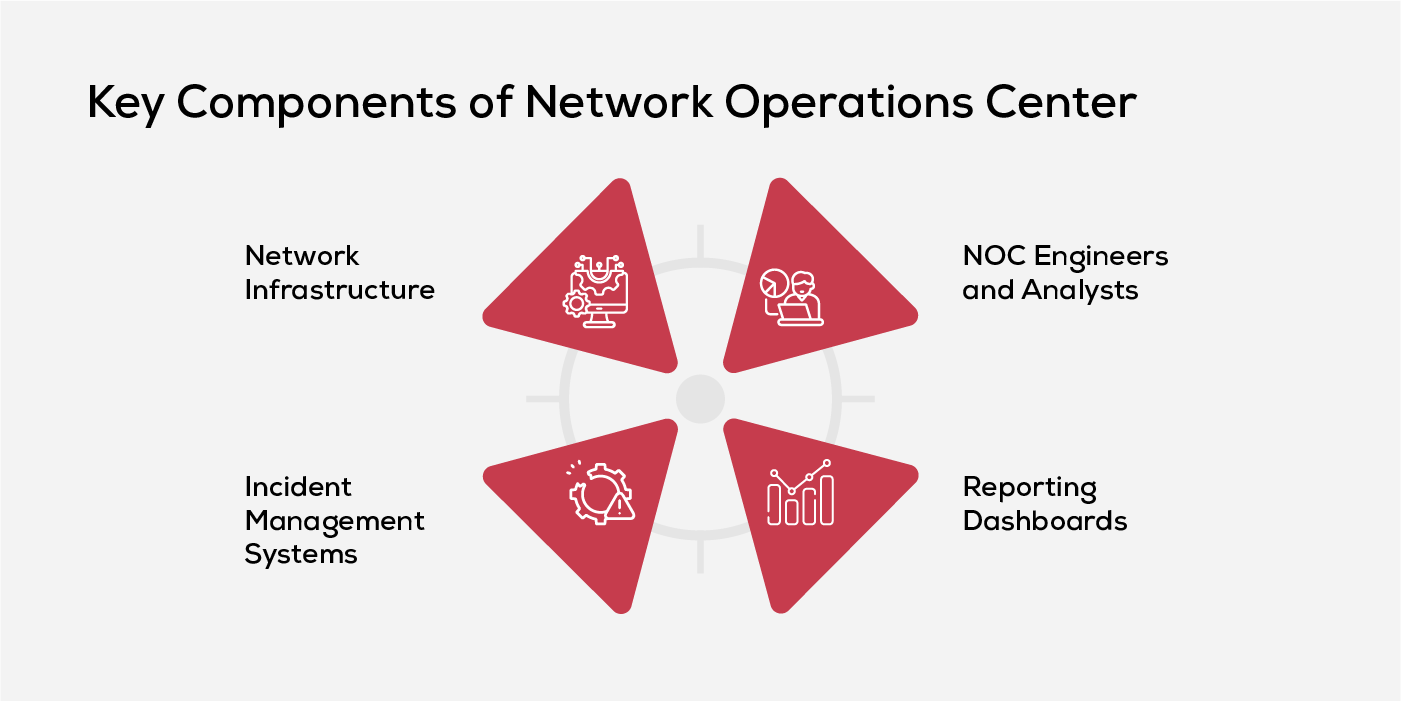
Network Infrastructure
The infrastructure monitored by a NOC can include on-premises networks, cloud environments, data centers and connected devices. Understanding the health and performance of these assets is essential for ensuring stable operations.
Incident Management Systems
When an issue is detected, incident management systems help teams record, prioritize, and track it through resolution. These platforms provide a structured approach to handling operational events and minimizing service impact.
NOC Engineers and Analysts
NOC engineers and analysts are responsible for overseeing day-to-day operations. They monitor alerts, investigate anomalies, coordinate responses and ensure that issues are addressed in a timely manner.
Reporting Dashboards
Reporting dashboards consolidate operational data into a single view, allowing teams to monitor the digital ecosystem, review performance trends and make informed decisions based on real-time insights.
How Does Network Operations Center Work?
While processes may vary across organizations, most NOCs follow a similar sequence of activities.
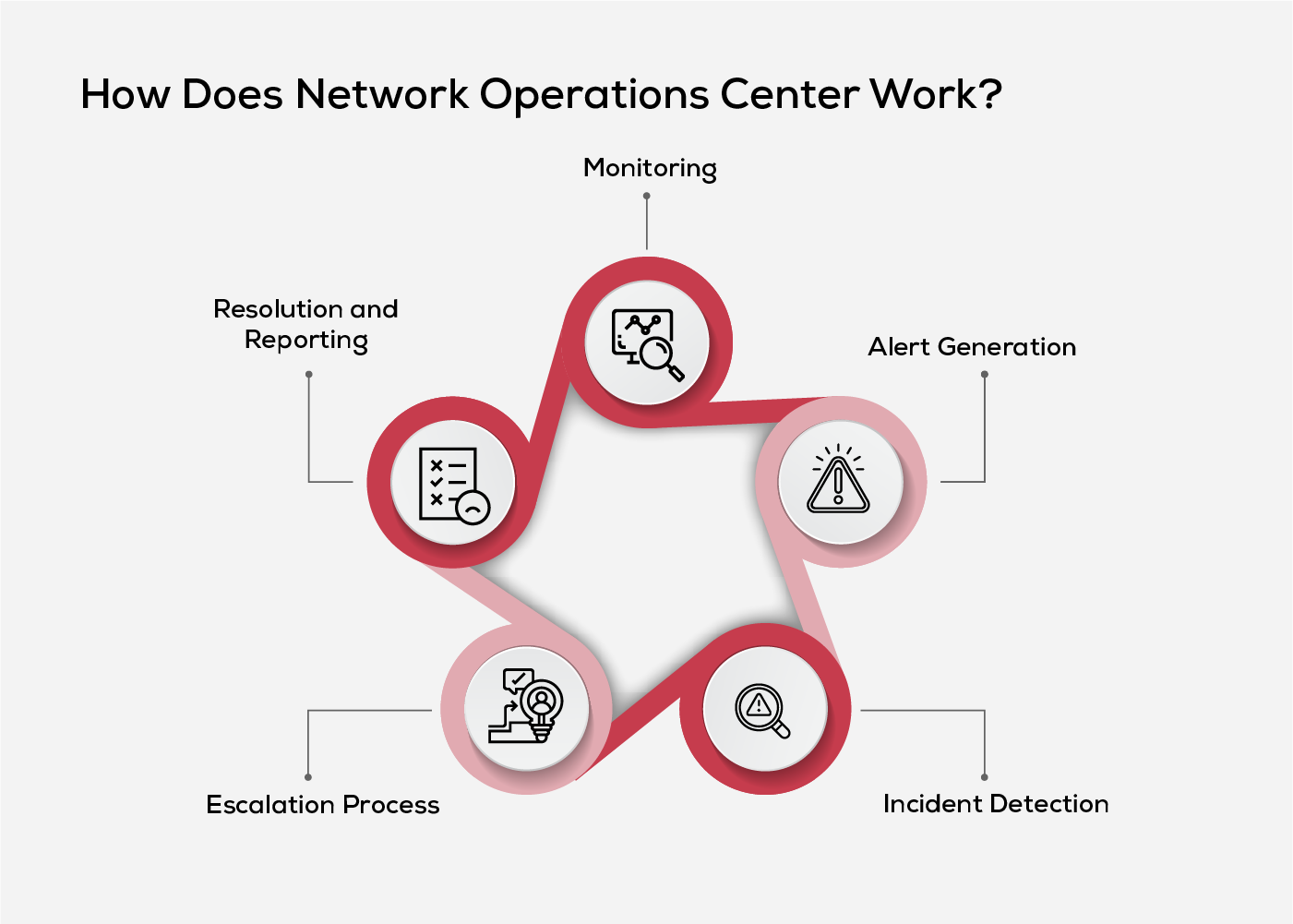
Monitoring
Monitoring involves continuously observing the state of IT systems to establish normal operating conditions and identify deviations that may indicate a developing issue.
Alert Generation
When a predefined threshold is exceeded or an abnormal condition is detected, monitoring platforms generate alerts. These notifications help teams focus on events that require attention.
Incident Detection
NOC personnel review alerts to determine whether they indicate a genuine operational issue. Once validated, the event is classified and logged for further action.
Escalation Process
Issues that require specialized expertise or additional resources are escalated to the appropriate teams. A well-defined NOC escalation process ensures that incidents are routed quickly and handled by the right stakeholders.
Resolution and Reporting
After the issue is resolved, teams document the actions taken, verify service restoration, and update records. Reporting activities help organizations analyze trends, improve response procedures, and strengthen overall incident response practices.
Common Challenges Faced by NOCs
As IT environments become increasingly distributed and interconnected, maintaining effective NOC operations can be challenging. Without the right processes, tools, and expertise, issues can escalate into service disruptions that affect both business performance and user experience.
1. Managing Diverse IT Environments
Maintaining consistent visibility across multiple environments can be difficult, making it harder to identify issues before they affect critical services. As a result, teams may experience longer troubleshooting cycles and reduced operational efficiency.
2. Handling High Volumes of Operational Alerts
Network alerting tools and monitoring platforms generate a continuous stream of notifications. When teams are overwhelmed by excessive alerts, critical issues can be missed or addressed too late. This can delay incident response and increase the likelihood of service interruptions.
3. Controlling Operational Costs
Maintaining monitoring platforms, supporting NOC infrastructure, and expanding operational capabilities require ongoing investment. Without a scalable operating model, costs can rise faster than business requirements, making it difficult to sustain efficient operations over time.
4. Keeping Pace with Technological Change
The growing adoption of cloud services, remote infrastructure monitoring, and modern IT architectures has increased the complexity of operational environments. Organizations that struggle to adapt their processes and tools may face visibility gaps, delayed intrusion detection and challenges in maintaining service reliability.
5. Reducing Service Disruptions
Identifying the root cause of issues across interconnected network stems is not always straightforward. Delays in diagnosis and remediation can prolong outages, complicate network outage management efforts, and increase the impact on business operations.
Benefits of Network Operations Center
A well-managed Network Operations Center helps organizations maintain greater control over their IT ecosystem. By combining continuous monitoring with structured operational processes, a NOC delivers several business and technical advantages.
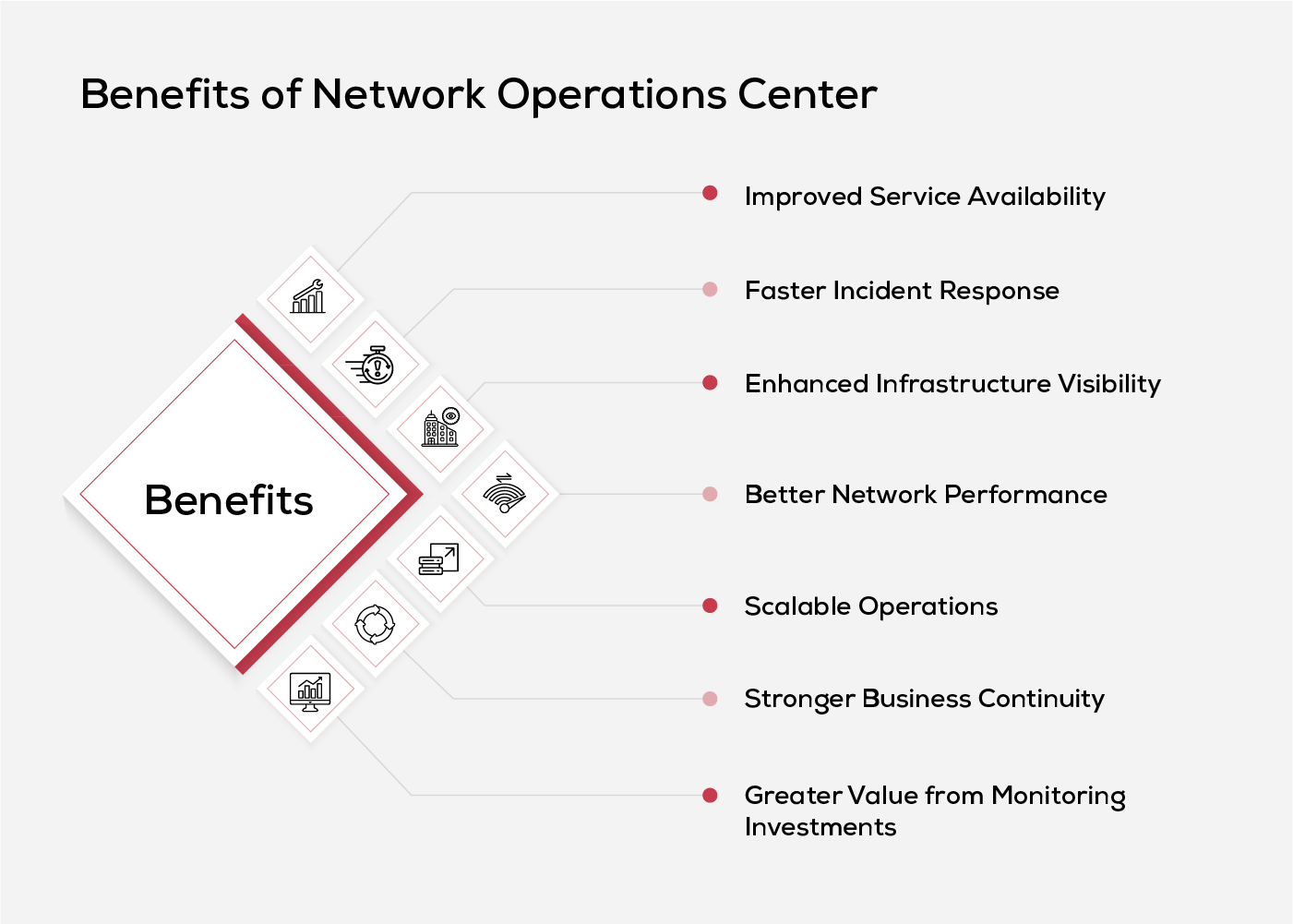
- Improved Service Availability
Continuous NOC monitoring helps teams identify and address issues before they escalate into major disruptions. This proactive approach supports service uptime monitoring and contributes to a more reliable IT environment.
- Faster Incident Response
Early detection and streamlined incident response management enable organizations to address operational issues more efficiently. Faster response times help minimize service impact and reduce recovery efforts.
- Enhanced Infrastructure Visibility
A NOC consolidates information from networks, servers, applications and cloud resources into a single picture. This makes IT infrastructure management more effective and allows teams to make informed decisions.
- Better Network Performance
Through continuous NOC performance monitoring, organizations can identify performance bottlenecks, optimize resource utilization, and maintain consistent service quality across their environments.
- Scalable Operations
As business requirements evolve, a NOC can support growth without compromising operational oversight. Enterprise monitoring solutions and modern operational frameworks help organizations manage expanding infrastructures more effectively.
- Stronger Business Continuity
By supporting proactive incident detection and reducing the likelihood of prolonged outages, NOCs help organizations maintain critical services and strengthen operational continuity.
- Greater Value from Monitoring Investments
By integrating network performance monitoring tools, cloud monitoring tools, and other operational platforms into a centralized framework, organizations can improve visibility while maximizing the value of their investments.
NOC Best Practices
Establishing a NOC is only the first step. To maintain operational effectiveness as environments evolve, organizations should adopt proven practices that support consistency, scalability and long-term performance.
1. Adopt a Proactive Monitoring Approach
Rather than relying solely on issue reporting, NOCs should leverage real time network monitoring to identify abnormal behavior and emerging risks early. Proactive monitoring enables teams to respond before issues develop into larger operational concerns.
2. Leverage NOC Automation
As infrastructure grows, manual processes can become difficult to sustain. NOC automation can streamline routine activities such as alert correlation, event prioritization and workflow execution, allowing teams to focus on higher-value operational tasks.
3. Define Clear Escalation Procedures
A structured NOC escalation process ensures that issues are routed to the appropriate teams without unnecessary delays. Clearly defined responsibilities and response paths help maintain consistency when managing events.
4. Establish Regular Reporting Practices
Periodic reporting helps teams identify recurring issues and service performance. Reviewing these insights regularly supports informed decision-making and strengthens the overall NOC management process.
5. Invest in Continuous Training and Knowledge Sharing
Technology environments continue to evolve, making ongoing learning essential for NOC teams. Regular training, knowledge-sharing initiatives, and well-maintained documentation help teams stay current with operational practices while reducing reliance on individual expertise.
6. Plan for Future Capacity Requirements
Infrastructure demands rarely remain static. Capacity planning helps organizations anticipate growth, allocate resources effectively, and support NOC implementation strategies that can scale alongside changing business needs.
How to Measure NOC Effectiveness?
The effectiveness of a Network Operations Center should be evaluated through measurable outcomes rather than operational activity alone. Tracking Key Performance Indicators (KPIs) helps organizations assess the overall impact of their NOC support operations.
Common metrics used to evaluate NOC performance include:
- Network availability
- Incident volume
- Mean Time to Detect (MTTD)
- Mean Time to Resolve (MTTR)
- First-call resolution rate
- Frequency of recurring incidents
- Time to impact assessment
Regularly reviewing these metrics enables organizations to identify areas for improvement, refine operational processes, and ensure that NOC services continue to align with business requirements.
How to Choose the Right NOC Service Provider?
When selecting a NOC service provider, organizations should evaluate factors beyond basic monitoring capabilities. Industry experience, well-defined SLA commitments, 24x7 infrastructure monitoring and the ability to support evolving business requirements are all important considerations. A scalable NOC services model supported by modern NOC tools and software can help ensure consistent operational oversight as IT environments grow in size and complexity.
Managing a NOC requires the right combination of technology, operational expertise, and round-the-clock oversight. Inspirisys helps organizations simplify this responsibility through a scalable NOC services model that supports on-premises, cloud, and hybrid environments. Using enterprise monitoring solutions, data center monitoring solutions, and IT operations management tools, Inspirisys enables organizations to maintain visibility across critical infrastructure, respond to operational issues efficiently, and support uninterrupted business operations.
Frequently Asked Questions
1. What is the difference between a NOC and a SOC?
A NOC focuses on monitoring and maintaining IT infrastructure to ensure systems remain available and perform reliably. In contrast, a SOC is responsible for network security operations, including identifying, investigating, and responding to cybersecurity threats.
2. How does communication flow through a NOC?
When an issue is detected, the NOC records it, notifies the relevant teams, and escalates it if needed. Updates are shared throughout the resolution process to ensure timely action and clear communication.
3. What are the essential tools used in a NOC?
A NOC typically uses network monitoring tools, fault management systems, ticketing and incident management platforms, cloud monitoring tools, system monitoring software, and reporting dashboards. These tools help teams monitor infrastructure, track issues, and manage daily operations.