
As customers increasingly expect seamless, connected and digital-first banking experiences, financial institutions are rethinking how they deliver services across multiple digital touchpoints. From mobile banking applications and payment platforms to fintech solutions and embedded financial services, banking is becoming part of a wider digital ecosystem. This shift is creating a need for banks to connect existing banking capabilities with modern applications, third-party platforms and emerging technologies while maintaining security and operational control.
API banking enables this connectivity by allowing banks to securely expose and integrate selected banking capabilities across authorised platforms and applications. As part of a broader core banking modernization strategy, API banking helps financial institutions build more flexible technology architectures, support new digital service models and respond to evolving customer expectations. By connecting core banking systems with an expanding digital ecosystem, APIs provide a foundation for the next generation of banking experiences.
Different Types of APIs in Banking
Banks use APIs in different ways depending on their intended users and business objectives:
- Internal APIs: Facilitate communication between a bank's internal applications, systems and business units, enabling services and data to be shared across the organisation.
- Partner APIs: Allow banks to connect with endorsed external partners, such as fintechs and merchants, to deliver integrated services, including payments, lending and account-related services.
- Open banking APIs: Enable authorised third-party providers to access designated banking data or initiate permitted services, subject to customer consent and applicable regulatory requirements.
These APIs can be supported by an API-first approach, in which they are considered early in the design and development of applications and services. An API-led approach, meanwhile, structures connectivity around reusable interfaces that can serve multiple applications and business processes.
How API Banking Differs from Traditional Integration
Traditional banking integrations rely on point-to-point connections, where each application requires a custom interface. As systems and partner ecosystems grow, these connections become increasingly complex to manage.
API-led connectivity replaces this model with standardised, reusable APIs that expose banking services to authorised applications. A single API can securely serve multiple channels, such as mobile apps, partner platforms, and internal systems, eliminating duplicate integrations.
APIs also shield core banking systems from direct access, acting as a controlled layer for requests, security, and service delivery. This allows banks to add new applications and partnerships faster, with minimal impact on core infrastructure.
Where API Banking Creates Business Value
The adoption of API banking is creating new opportunities for banks to innovate, scale services and respond more quickly to changing market demands.
Accelerating Product and Service Innovation
Banks can reduce the time and effort required to develop new products by building on existing technology capabilities instead of creating every component from scratch. Reusing established services and functionality helps minimise duplicate development efforts across products, accelerate the delivery of new offerings, and bring services to market more quickly. It also gives product teams greater flexibility to test new ideas, gather customer feedback, and refine solutions based on business and user requirements.
Expanding Market Reach Through Embedded Finance
API banking can support new distribution models by allowing financial services to become part of customers' everyday digital activities. This enables banks to deliver products and services within the customer journey, making them available when they are most relevant to customer needs. As a result, banks can offer financing options during online purchases, enable payments and digital wallet services within partner platforms, and reach new customer segments through ecosystem partnerships.
Delivering More Relevant Customer Experiences
With access to customer information and transaction activity, banks can deliver more relevant and timely experiences. This can include recommending products that align with a customer's financial needs and behaviour, providing useful account insights and guidance through digital channels, and simplifying interactions by presenting relevant information at the right stage of the customer journey.
Streamlining Lending and Payment Operations
API banking can also help simplify operational processes by enabling information to flow more consistently across systems and functions. By connecting services and reducing reliance on manual intervention, banks can improve process execution, increase operational visibility, and support more efficient service delivery. This can include streamlining information exchange across lending workflows, improving coordination throughout payment processing, and reducing repetitive administrative tasks through greater automation and system integration.
The Technology Architecture Behind API Banking
API banking can be implemented using different architectural approaches, depending on how banks organise their technology systems and deliver digital services. Understanding these approaches helps explain how banks can structure their API environments to support their business and modernization goals.
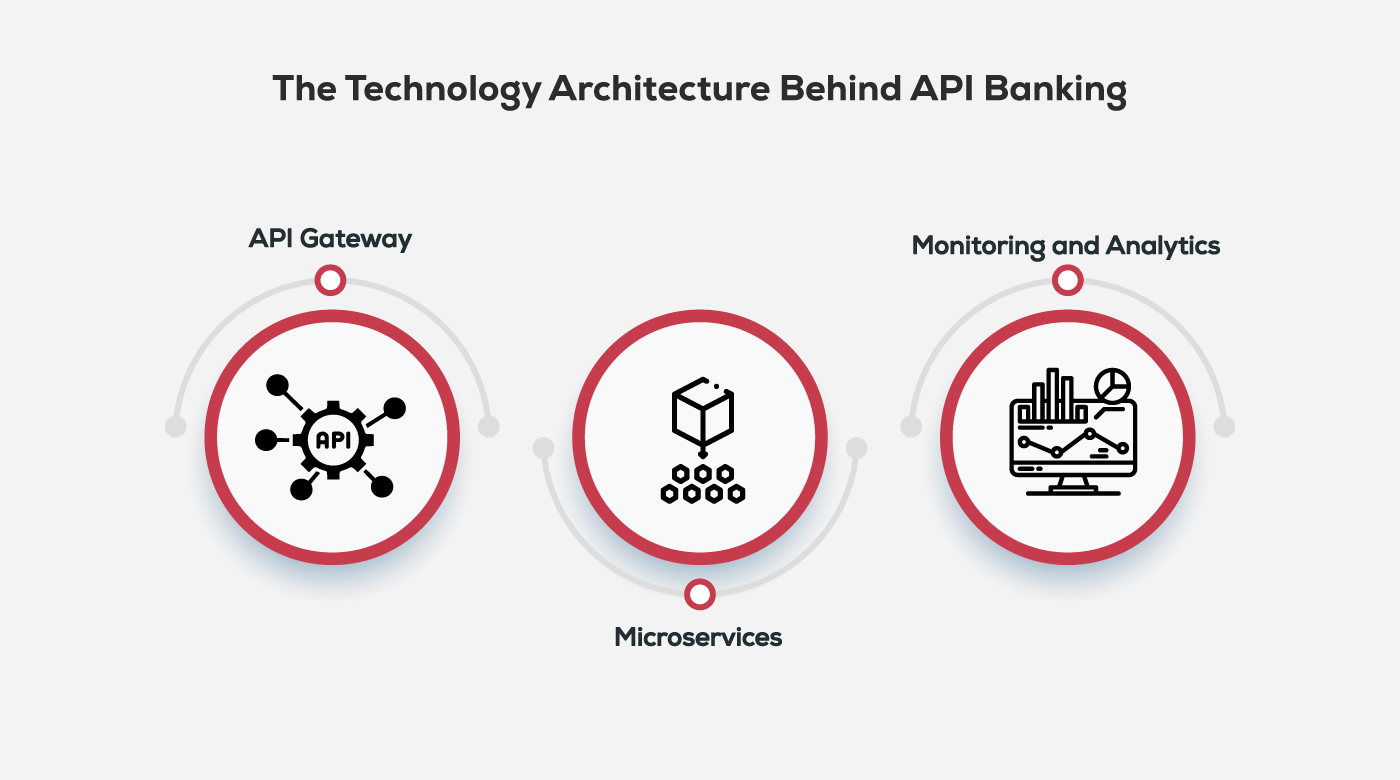
API Gateway and Management
An API gateway acts as a central entry point for API requests, helping banks manage communication between applications and their services. It can support several functions:
- Traffic management: Routes API requests and manages traffic volumes to help maintain service availability and performance.
- Authentication and access control: Verifies the identity of users or applications and enforces permissions for accessing specific services.
- API management: Supports the application of access policies, request limits and other controls across APIs.
The gateway works alongside the API layers rather than replacing them. It provides a common point for managing incoming requests, while the individual APIs handle access to data and the coordination or presentation of banking services.
Microservices and Modular Architecture
Microservices organise applications into smaller, independently deployable services, each responsible for a specific business function, such as payments, identity verification or account management. Where appropriate, banks can use this approach to develop, update and scale selected services without making changes to an entire application.
When combined with API-based integration, a modular architecture can help banks introduce new capabilities and make targeted changes to existing services. For example, a bank may update its payment service independently of its account management application, provided that the dependencies and interfaces between them are appropriately managed.
Monitoring and Analytics
Monitoring and analytics provide visibility into API activity and help banks understand how their services are performing. These capabilities support the ongoing management of API-based services through:
- Usage tracking: Measuring API request volumes and identifying usage patterns across applications and partners.
- Performance monitoring: Tracking response times, availability and other service-level indicators.
- Failure detection: Identifying errors, failed requests and service disruptions to support troubleshooting and resolution.
- Operational insights: Analysing performance and usage data to identify bottlenecks, understand service demand and inform capacity planning.
The right combination of these architectural components depends on each bank's technology environment, business requirements and modernization priorities. Some institutions may introduce API gateways and layered APIs around their existing core systems, while others may adopt microservices or additional architectural patterns as their needs evolve. A phased approach can allow banks to extend API capabilities while managing changes to existing systems.
API Banking and Legacy Core Modernization
Replacing a legacy core banking system can involve extensive technical changes, data migration and operational risk. An API-led approach gives banks another way to approach this challenge by creating a controlled interface around existing infrastructure and enabling selected components to be modernized over time.
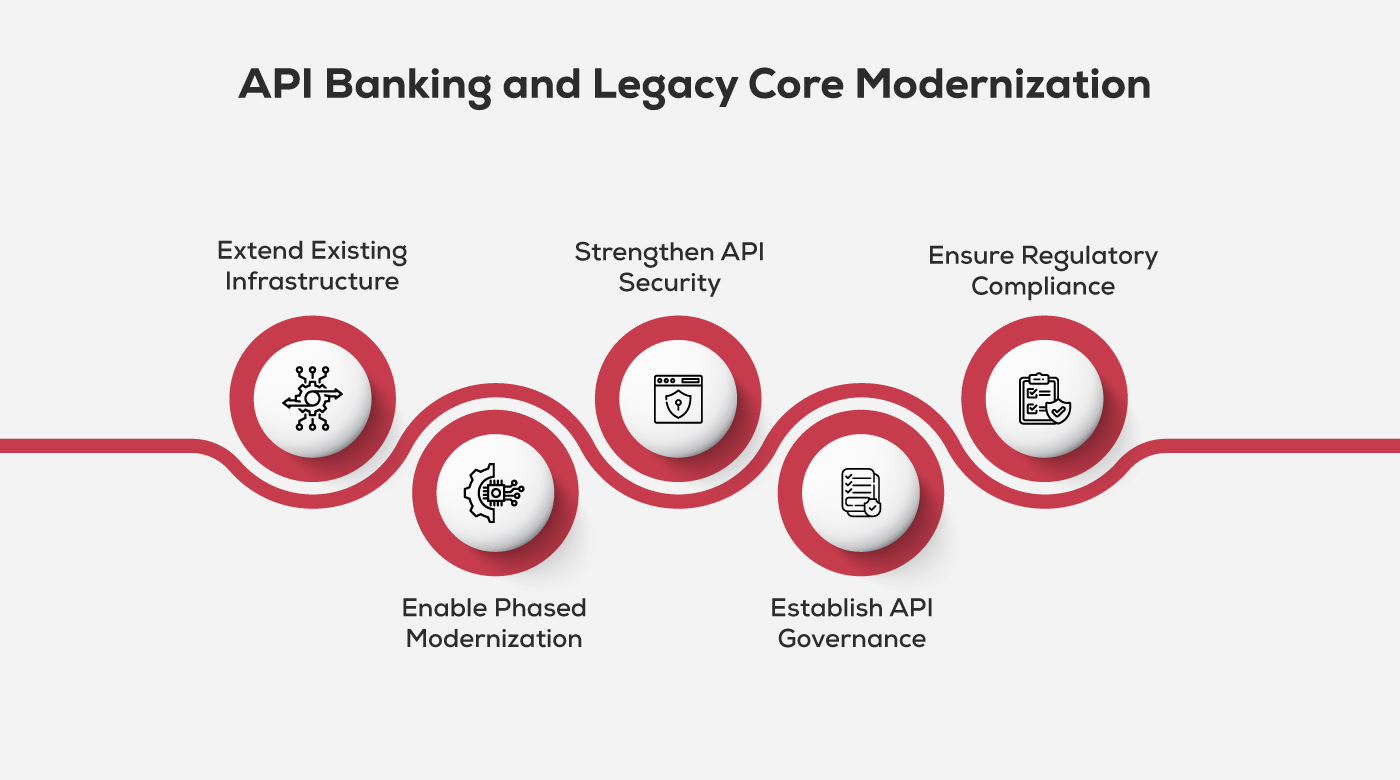
Extending the Use of Existing Core Infrastructure
API banking can also help simplify operational processes by enabling information to flow more consistently across systems and functions. By connecting services and reducing reliance on manual intervention, banks can improve process execution, increase operational visibility, and support more efficient service delivery. This can include streamlining information exchange across lending workflows, improving coordination throughout payment processing, and reducing repetitive administrative tasks through greater automation and system integration.
Modernizing Core Systems in Phases
Instead of undertaking a complete replacement at once, banks prioritize individual components for enhancement, migration or retirement according to business needs and technical dependencies. API-based integration supports this phased approach by helping maintain communication between existing and newer components during the transition.
For instance, a bank might retain its account management system while migrating a separate payment component to a newer platform. Once the new component has been integrated and validated, the bank can assess other areas for modernization, guided by operational readiness and the overall technology roadmap.
Security, Governance and Compliance Considerations
A coordinated approach to security, governance and compliance helps manage the risks associated with exposing banking capabilities to internal applications and external partners.
Security
APIs need safeguards at every stage of data exchange to prevent unauthorised access and detect potential threats. Key measures include:
- Authentication and authorization: Verify the identity of users and applications and restrict access according to their permissions.
- Encryption: Protect sensitive information during transmission and storage.
- Secure endpoints and access controls: Apply security policies to API endpoints, limit access to necessary resources and enforce appropriate request restrictions.
- Threat detection and monitoring: Track API activity to identify suspicious access patterns, unusual traffic and potential attacks.
Governance
A clear governance framework helps banks manage their APIs consistently as the number of services and integrations grows. It should define:
- API ownership: Assign responsibility for each API, including its maintenance and security.
- Standardisation and documentation: Establish common design standards and maintain clear documentation for developers and partners.
- Version and lifecycle management: Control updates, backward compatibility, deprecation and retirement of APIs.
- Usage monitoring: Check API activity and review usage against organisational policies.
Compliance
Banks must ensure that API access and data sharing comply with applicable regulatory and privacy requirements. This includes managing customer consent, restricting third-party access to authorised purposes and maintaining audit trails of API activity. Access permissions and data-sharing arrangements should be reviewed as regulations and business relationships evolve.
Expanding API access without consistent governance can lead to API sprawl, uneven security controls and increased operational complexity. API banking should therefore be managed as an enterprise architecture and governance initiative, with security, compliance and lifecycle management built into its design and ongoing operation.
Preparing for API Banking
Preparing for API banking starts with understanding an organisation's readiness, defining clear business priorities and identifying the skills and partnerships needed to put its plans into practice. For banks, this includes assessing existing capabilities and determining where API adoption fits within their modernization roadmap. For businesses, it means evaluating how API-enabled financial services could support their operating models and customer offerings.
The priority is to move from exploring API banking to building a practical, well-defined plan for adoption, with clear ownership, measurable objectives and a realistic view of the investment and change involved.
Frequently Asked Questions
1. Is API banking the same as open banking?
API banking refers to the use of application programming interfaces to connect banking systems, services and applications. Open banking is a broader framework that enables customers to permit authorised third parties to access designated financial information or services. Open banking commonly uses APIs, while API banking can also support private integrations between banks and business partners.
2. What is the difference between API banking and Banking-as-a-Service (BaaS)?
API banking provides the technical interfaces through which banking services can be accessed and integrated. Banking-as-a-Service (BaaS) is a business model in which a licensed financial institution makes banking capabilities available to third-party businesses, often through APIs. These businesses can then incorporate financial services into their own products and customer experiences.
3. Can banking APIs initiate transactions, or are they used only to access financial data?
Banking APIs can support both data access and transaction-related activities, depending on the services exposed and the permissions granted. They can provide account information, retrieve transaction details, initiate payments and facilitate fund transfers through authorised applications.
4. Can businesses integrate banking APIs with their existing enterprise applications?
Yes. Businesses can integrate banking APIs with applications such as enterprise resource planning (ERP), treasury management, accounting and payment systems, subject to the APIs and integration capabilities offered by their banks. This can help automate activities such as balance retrieval, payment initiation and transaction reconciliation.