
Core banking systems were built to process transactions reliably, manage accounts at scale and support branch-based operations. Today, digital-first banking demands instant payments, seamless digital experiences and faster responses to changing customer expectations.
However, many legacy banking systems struggle to meet these demands. Limited integration, batch-based processing and fragmented data can slow service delivery and make it harder to introduce new capabilities. Banks must also manage security, regulatory compliance and operational risks while updating their technology.
Core banking modernization helps address these challenges by improving system flexibility, connectivity and scalability. This blog explores five strategies that can help banks modernize legacy systems, strengthen operational resilience and build a foundation for evolving digital banking needs.
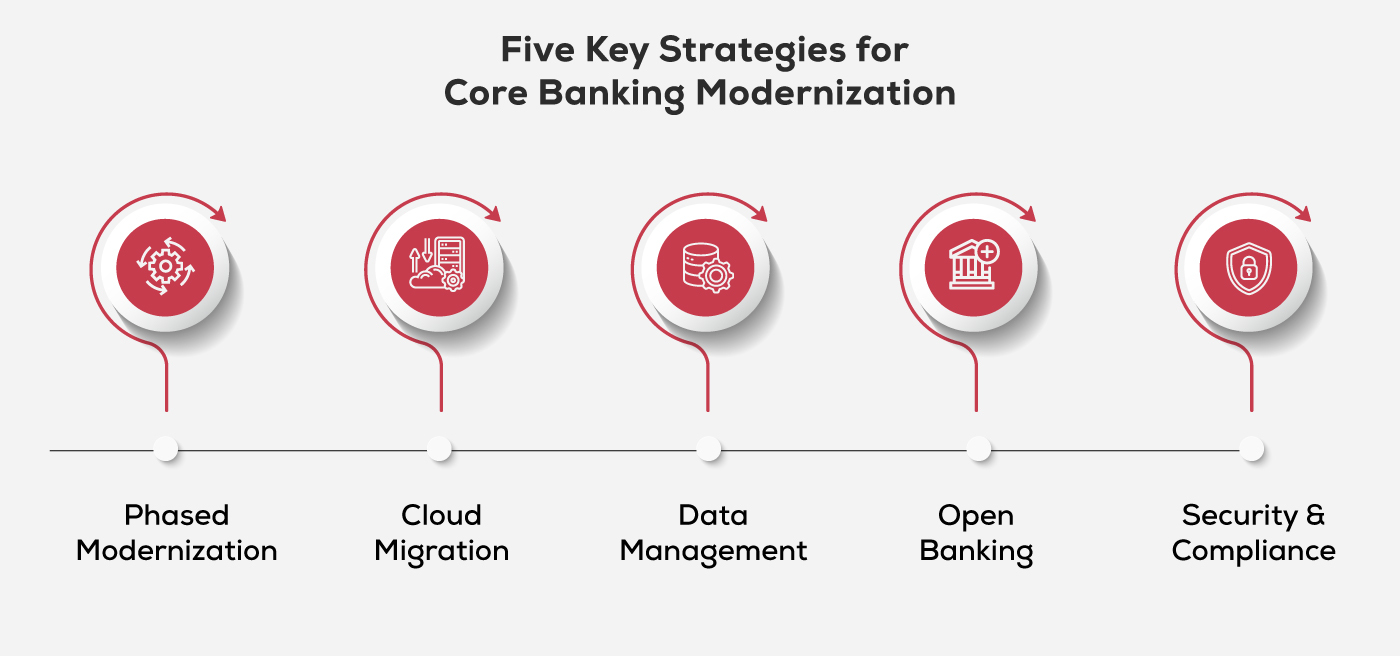
Banks can modernize core banking systems through a combination of architectural, infrastructure and operational changes. The right approach depends on existing technology constraints, business priorities, risk tolerance and long-term digital goals. The following strategies outline how banks can improve flexibility, support real-time services and connect digital ecosystems, while modernizing legacy environments.
1. Take a Phased Approach to Modernization
Banks can take a phased approach to core banking modernization, upgrading systems and capabilities in stages to align with business priorities, manage implementation complexity and maintain operational continuity. This approach allows institutions to modernize selected areas without transforming the entire environment at once.
Common approaches include extending legacy cores with modern digital layers and APIs, replacing capabilities domain by domain, or gradually migrating products and customers to a new platform while legacy and modern systems operate in parallel. Each approach requires effective integration between existing and new components to maintain data consistency and service continuity. While running both systems in parallel can reduce cutover risks, it also introduces data synchronization and operational complexities.
To manage these challenges, banks should define clear milestones, test integrations and validate data at each stage before moving changes into production. This helps identify issues early and supports a controlled transition while keeping critical banking operations stable.
2. Move Critical Workloads to the Cloud
Banks should assess their core banking workloads to determine which systems can be migrated to the cloud and which may need to remain on-premises. Applications with fewer dependencies may be suitable for earlier migration, while transaction-intensive or highly sensitive workloads may require additional evaluation.
The choice between public cloud, private cloud, hybrid infrastructure or an on-premises environment should depend on workload requirements, performance, data protection and regulatory obligations. Banks should also assess disaster recovery capabilities, third-party dependencies and integration requirements before deciding on a migration approach.
A workload-based migration plan helps banks prioritize where cloud adoption can deliver value while maintaining control over critical banking operations. Regular performance reviews and risk assessments can then help determine whether the chosen environment continues to meet operational and compliance requirements.
3. Build a Unified Data Foundation
Banks can strengthen their core banking environments by modernizing how customer, account and transaction data is structured, managed and exchanged across systems. Establishing consistent data definitions and improving integration between legacy core platforms, digital channels and other banking applications can support more reliable data exchange and simplify the introduction of new services.
Banks should assess their existing data structures, standardize key data definitions and establish consistent validation and governance practices. Where required, they can also restructure or migrate legacy data to support modern platforms and applications.
Banks should also establish clear data ownership, access controls and data-quality checks to maintain accuracy, security and consistency. These practices also help prepare banking data for advanced analytics and AI applications, where reliable, well-governed information is essential.
4. Expand Through Open Banking Partnerships
Banks should identify areas where collaboration with fintechs and third-party providers can extend their existing services and improve customer experiences. This starts with assessing customer needs and business priorities to determine which external capabilities, such as account aggregation, payment initiation or personal financial management, could add value to their digital banking offerings.
Once priority areas are identified, banks should establish a framework for selecting partners, defining service responsibilities and setting conditions for data access. Customer consent, access permissions, security controls and third-party risk assessments should be built into the partnership model to ensure that financial information is exchanged securely and in accordance with applicable regulations.
Banks should also define how these partnerships will be integrated into their service delivery models and evaluated over time. Monitoring service performance, customer adoption and compliance can help institutions determine which collaborations to expand and where adjustments are needed.
By taking a structured approach to open banking partnerships, banks can extend their service offerings and participate in connected financial ecosystems without having to develop every capability internally.
5. Strengthen Security and Compliance from the Start
Security and compliance should be built into modernization programs from the outset rather than adding after implementation. Integrating governance, risk management, and regulatory considerations into transformation planning helps ensure that modernization efforts remain aligned with business and compliance objectives.
As core systems, workloads and data are migrated to modern platforms, banks need a structured approach to managing operational and transformation risks. Embedding security controls throughout the modernization lifecycle helps maintain resilience while supporting ongoing change.
A strong governance framework also provides the oversight needed to navigate evolving regulatory requirements and maintain trust across customers, partners, and stakeholders.
Conclusion
Core banking modernization is most effective when viewed as a strategic evolution of the bank's operating foundation rather than a standalone technology initiative.
Success depends on bringing together innovation, customer expectations, operational resilience, and regulatory requirements within a modernization roadmap that supports both current priorities and long-term objectives. A well-planned core banking modernization programme must align technology decisions with the bank's operational needs and long-term business goals. The right implementation partner can help translate these priorities into practical outcomes.
Inspirisys supports banks through its Finacle services, including implementation, customization, upgrades, system integration, testing, data and post-implementation support, helping financial institutions manage their core banking requirements through the platform's lifecycle. The goal is not simply to modernize systems, but to create an environment where new products, services, and business models can be introduced with greater agility.

Frequently Asked Questions
1. What is a core banking architecture?
Core banking architecture defines how a bank’s core applications, databases, transaction processing engines and external systems interact. Modern architectures often use distributed components, APIs and event-driven integration to support scalability and real-time processing.
2. What is the role of middleware in core banking systems?
Middleware connects core banking platforms with digital channels, payment networks and third-party applications. It facilitates data exchange, message routing and system interoperability without requiring every application to connect directly to the core.
3. What is high availability in core banking?
High availability keeps core banking services operational by minimizing downtime through redundancy, failover mechanisms and continuous system monitoring. Combined with disaster recovery and data replication, it helps banks maintain service continuity during infrastructure failures or disruptions.
4. What technologies are used in core banking modernization?
Core banking modernization may involve API gateways for connecting banking applications, microservices for separating core functions, containers for deploying workloads, and event streaming for processing transaction events. Banks may also use automated testing and DevSecOps pipelines to validate changes and deploy updates with greater control.