
Core banking systems power the day-to-day operations of modern banks, supporting everything from account management and transaction processing to financial recordkeeping and service delivery across branches, ATMs, mobile apps and digital platforms.
As banks accelerate modernization and expand their digital capabilities, securing these systems has become a strategic priority. Effective core banking security helps protect critical financial data, supports uninterrupted operations and strengthens customer trust. Recognizing common vulnerabilities and implementing the right security measures allows banks to reduce risk while supporting innovation and growth.
Key Security Risks in Core Banking
Core banking security faces multiple threats, ranging from software vulnerabilities and unauthorized access to data manipulation and cyberattacks. Identifying these risks is essential to understanding how security gaps can compromise financial information, transaction accuracy and banking operations.
Legacy System Vulnerabilities
Legacy core banking systems may contain outdated software, unsupported components and obsolete architectural dependencies. These weaknesses leave banking applications susceptible to known exploits, while compatibility constraints complicate security updates and increase exposure to cyber threats.
Identity and Access Compromise
Stolen credentials, compromised privileged accounts and excessive user permissions can provide unauthorized access to core banking applications. Insider threats further amplify this risk, as individuals with legitimate access may misuse their privileges to expose sensitive customer information, manipulate data or perform actions beyond their authorized responsibilities.
API and Integration Risks
APIs serve as the connective layer between core banking platforms, digital channels, payment networks and third-party ecosystems. Security weaknesses within these integrations expose critical services and data flows to unauthorized requests and abuse. Flaws in authentication, input validation or business logic enable attackers to manipulate transactions, access restricted functions and compromise the integrity of connected banking services.
Data Breaches and Transaction Manipulation
A breach of core banking data exposes personally identifiable information, account details and sensitive financial records, creating significant operational, regulatory and reputational risks. Transaction manipulation, meanwhile, involves unauthorized alterations to account balances, beneficiary information or payment instructions, compromising the integrity of financial data and facilitating fraudulent activities within the banking ecosystem.
Third-Party and Supply Chain Exposure
Vulnerabilities in third-party banking software, vendor networks and outsourced IT services introduces security risks through the technology supply chain. Compromised software updates, external service dependencies or vendor access to sensitive systems may expose banks to threats originating outside their direct infrastructure.
Ransomware and Service Disruption
Ransomware attacks encrypt critical banking data, disable applications or make essential systems unavailable. Distributed Denial-of-Sservice (DDoS) attacks can also overwhelm banking services, preventing customers from accessing digital channels and disrupting transaction processing. These incidents can result in downtime, operational losses and prolonged service recovery.
Core Banking Security Best Practices
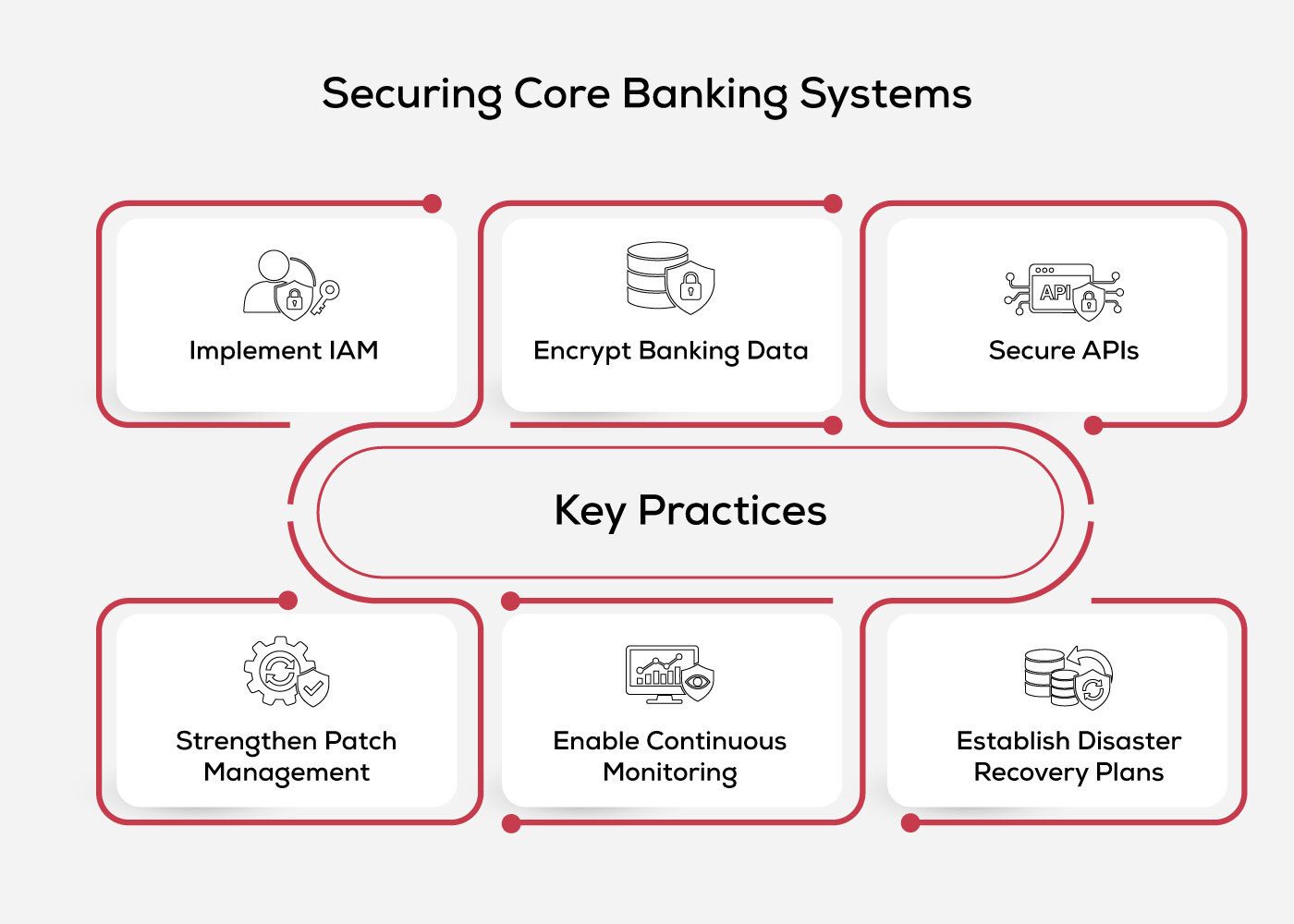
Effective core banking security best practices requires a layered approach that addresses access control, data protection, application security and operational resilience. Banks can strengthen their security posture by adopting proven controls, identifying vulnerabilities early and integrating security into routine IT operations.
Implement Strong Identity and Access Management
Adopt robust Identity and Access Management (IAM) practices to prevent unauthorized access to core banking systems. Enforce Multi-Factor Authentication (MFA), Role-Based Access Control (RBAC) and the principle of least privilege to ensure users can access only the applications and data required for their roles. Regular access reviews can help identify excessive permissions and reduce the risk of credential misuse.
Encrypt Sensitive Banking Data
Protect customer information and financial records through data encryption at rest and in transit. Use established encryption standards and secure key management practices to prevent unauthorized parties from accessing sensitive information. Data masking and tokenization can further limit exposure when handling confidential banking data in testing, analytics and other non-production environments.
Secure APIs and Banking Integrations
Strengthen the security of integrations across core banking platforms, payment ecosystems, mobile banking channels and third-party services. Enforce strong authentication, rigorous input validation, rate limiting and encrypted communications to protect critical interfaces. Regular security assessments help identify and remediate weaknesses, while continuous monitoring ensures the integrity, reliability and security of data exchanges across interconnected banking systems.
Strengthen Vulnerability and Patch Management
Establish a structured vulnerability management program to continuously identify, assess and remediate security weaknesses across core banking applications, databases, operating systems and supporting infrastructure. Conduct regular vulnerability assessments and penetration testing, prioritize remediation based on risk and business impact, and deploy security updates in a timely manner. For legacy environments that cannot be patched immediately, implement compensating controls such as network segmentation, application whitelisting and enhanced monitoring to reduce exposure and maintain a strong security posture.
Enable Continuous Security Monitoring
Use Security Information and Event Management (SIEM) tools to consolidate security logs and identify suspicious activity across core banking applications and infrastructure. Monitor privileged account usage, unusual login patterns, anomalous transactions and potential indicators of compromise. Timely alerts and coordinated incident investigation can help security teams detect threats earlier and limit their impact.
Establish Incident Response and Disaster Recovery Plans
Develop and regularly test incident response and disaster recovery plans to maintain business continuity during cyber incidents. Define escalation procedures, assign response responsibilities and maintain secure, recoverable backups of critical banking data. Test recovery processes against established Recovery Time Objectives (RTOs) and Recovery Point Objectives (RPOs) to assess how quickly systems can be restored and how much data loss can be tolerated.
Why Core Banking Security is Important
Effective core banking security delivers value beyond protecting IT infrastructure. It helps banks preserve customer confidence, meet regulatory expectations and maintain the reliability of financial services.
Customer Trust and Confidence
Customers expect their financial information and transactions to remain secure. A strong security posture reinforces confidence in digital banking services and helps banks maintain long-term customer relationships.
Regulatory Compliance
Banks operate under strict regulatory and data protection requirements. Effective security governance helps them meet applicable compliance obligations, maintain audit readiness and reduce the risk of regulatory penalties.
Financial and Reputational Protection
Security incidents can result in direct financial losses, legal costs and reputational damage. Protecting core banking operations helps safeguard a bank's financial standing and preserve its credibility in a competitive market.
Conclusion
Securing core banking systems requires continuous evaluation of existing controls, technology vulnerabilities and evolving threats. By prioritizing improvements based on business criticality and regularly reviewing their security posture, banks can strengthen resilience as their technology environments evolve.
Inspirisys offers Enterprise Security services, including security monitoring, vulnerability assessment and penetration testing, to help organizations strengthen their security posture. With the right security expertise, banks can work towards protecting customer confidence, maintaining operational stability and enabling sustainable digital transformation.
Frequently Asked Questions
1. What is the difference between core banking security and cybersecurity?
Core banking security focuses on protecting banking applications, customer account data and financial transactions. Cybersecurity has a broader scope, covering networks, devices, applications and digital infrastructure across an organization.
2. How does core banking modernization affect security?
Core banking modernization can introduce security considerations related to data migration, legacy system compatibility, cloud infrastructure and third-party integrations. Incorporating security into modernization planning helps banks manage these challenges while improving system scalability and performance.
3. What are the RBI and data protection requirements for core banking systems in India?
Indian banks must comply with applicable RBI directions on IT governance, cybersecurity and data security. The Digital Personal Data Protection Act, 2023, and the DPDP Rules, 2025, also establish requirements for handling digital personal data, subject to their respective implementation timelines and applicability.
4. What challenges do banks face when migrating to a new core banking system?
Core banking migration can involve complex data transfers, compatibility issues, service continuity concerns and integration challenges. Banks must also consider data integrity, regulatory obligations and potential security gaps during the transition to ensure a reliable migration with minimal disruption to banking operations.