
Banks rely on interconnected systems to process transactions, manage customer information, and deliver services across digital channels. As banks expand their technology ecosystems with new applications and external services, ensuring reliable data exchange across these systems becomes essential for maintaining efficient operations.
Core banking integration addresses this need by connecting bank’s central system of record with the applications and platforms that support its operations. Effective integration enables consistent information flow, coordinated processes, and reliable service delivery across the banking ecosystem.
However, integrating these systems presents challenges related to legacy infrastructure, system compatibility, and many more. Understanding these complexities is essential for selecting the right integration approach. This article examines the key challenges in core banking integration and the strategies banks can adopt to overcome them while building a more connected and adaptable banking ecosystem.
Common Challenges in Core Banking Integration
Integrating core banking systems requires banks to reconcile differences in technology, data structures, security requirements, and operational demands. These challenges can affect implementation timelines, system reliability, and the ability to introduce new banking capabilities.
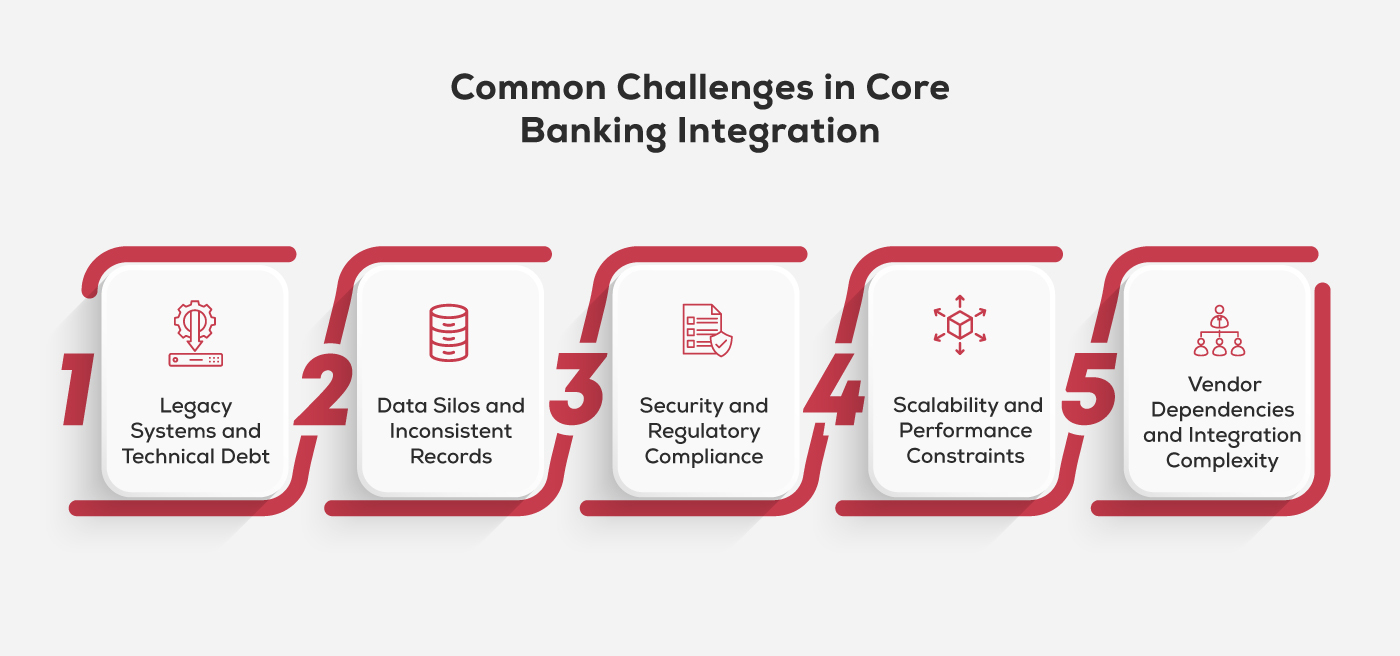
1. Legacy Systems and Technical Debt
Many banks operate core banking platforms that have undergone years of modifications and customizations. These changes can create tightly coupled components, outdated interfaces, and undocumented dependencies. Integrating modern applications with such environments may require extensive code changes or additional adaptation layers. Banks must also manage the risk of disrupting existing banking operations when modifying established systems.
2. Data Silos and Inconsistent Records
In many banks, customer and operational data resides across multiple systems, each maintaining its own records and data formats. When products, channels, and applications grow over time, information can become scattered across the organization rather than connected through a single view. This fragmentation makes it harder to consolidate information across systems. Differences in how applications record customer, account, or transaction data can also result in duplicate entries or conflicting values, affecting reporting accuracy, operational processes, and the ability to build a complete picture of customer relationships.
3. Security and Regulatory Compliance
Connecting core banking systems with multiple applications and external services expands the paths through which sensitive financial and customer data can be accessed or transferred. Differences in authentication mechanisms and access permissions can leave gaps that increase the risk of unauthorized access or data exposure. Inconsistent audit trails can also make it harder to trace data exchanges and investigate suspicious activity.
4. Scalability and Performance Constraints
Maintaining fast and reliable data exchange across integrated banking systems can be difficult when APIs, middleware, or network connections become performance bottlenecks. Multiple service calls can add latency, while poorly managed timeouts, retries, and failed requests can delay transactions or interrupt services. These constraints can limit throughput during peak loads, even when individual systems have sufficient processing capacity.
5. Vendor Dependencies and Integration Complexity
Integrating products from different vendors can be difficult when their interfaces, communication protocols, or data specifications require additional adaptation to work together. Some vendors may restrict access to technical documentation or integration tools, limiting a bank's ability to modify connections independently. Licensing conditions, vendor-controlled upgrade schedules, and reliance on external support for configuration changes can also increase implementation costs and delay integration projects.
Strategies for Successful Core Banking Integration
Successful core banking integration depends on making informed architectural decisions, establishing clear implementation priorities, and planning for ongoing system maintenance. The following strategies outline practical approaches banks can use to manage integration projects effectively .
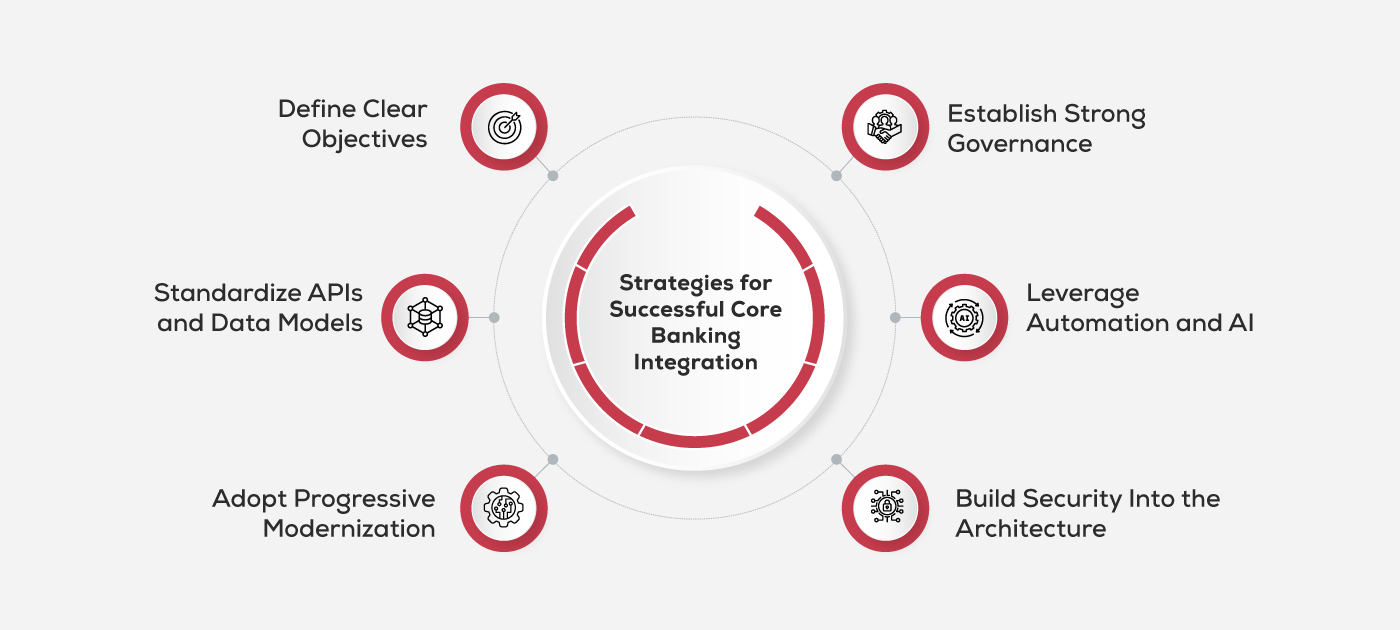
Define Clear Objectives
Core banking integration should begin with an assessment of existing systems, business processes, and operational bottlenecks. Banks need to identify what they want to improve, whether that means reducing transaction processing errors, simplifying regulatory reporting, lowering legacy maintenance costs, or resolving customer issues faster. These objectives help determine which systems need to connect, establish priorities for implementation, and provide measurable criteria for evaluating the results.
Standardize APIs and Data Models
Establish common API conventions and data models to give banks a consistent basis for connecting applications and exchanging information. Standardized interfaces define how systems communicate, while agreed data structures help ensure that customer details, account identifiers, and transaction records are interpreted consistently across applications.
Develop reusable APIs and integration components to minimize duplicated development effort when connecting additional services. Align these standards with shared business requirements while accommodating the technical constraints of individual systems.
Adopt Progressive Modernization
Banks can modernize core banking systems in phases, prioritizing specific modules, functions, or applications instead of replacing the entire platform at once. Integration layers can connect existing systems with modern applications during this transition, allowing banks to introduce new capabilities while maintaining essential banking operations. Each phase should have defined objectives, dependencies, and validation criteria before further changes are introduced. This approach helps control implementation risks, manage costs, and demonstrate value progressively.
Build Security Into the Architecture
Security should be considered from the outset of an integration initiative. Banks need an architecture that supports secure access and oversight across the environment.
This includes applying zero-trust principles, implementing multi-factor authentication, maintaining continuous monitoring and establishing appropriate consent and access controls. Embedding these measures into the integration architecture helps support both security and compliance requirements as the ecosystem grows.
Leverage Automation and AI
Banks must integrate automation and AI into integration workflows to streamline data mapping, monitor API activity, and identify potential failures. Automated data mapping aligns information across systems, while AI-assisted monitoring flags unusual traffic patterns and performance anomalies for investigation. Predictive analytics helps identify early signs of integration issues, giving IT teams time to investigate and resolve them before banking services are disrupted.
Effective implementation requires reliable data inputs, clearly defined monitoring parameters, and validation of AI-generated alerts to support accurate decisions and timely responses.
Establish Strong Governance
Banks should establish clear ownership and accountability for integration initiatives, with defined responsibilities for decision-making, change approvals, and issue resolution. A governance framework should also set standards for integration design, documentation, and coordination between business and technology teams. Regular reviews of project progress, costs, service performance, and adherence to established standards help maintain oversight and guide improvements across the integration lifecycle.
Moving Towards Integrated Core Banking Systems
Core banking integration requires technology decisions that account for each bank’s existing infrastructure, operational priorities, and modernization plans. Choosing the right approach and technology partner is essential to aligning integration initiatives with these requirements.
Inspirisys brings core banking expertise through its work with Finacle solutions, supporting banks in addressing their core banking technology needs. By aligning technology capabilities with specific business requirements, banks can plan their next steps in core banking modernization with greater clarity.

Frequently Asked Questions
1. What are the different core banking architectures?
The main core banking architectures include monolithic, modular, service-oriented, and cloud-native architectures, each offering different levels of flexibility, scalability, and ease of modernization.
2. What is the difference between core banking integration and core banking modernization?
Core banking integration connects existing systems and applications to enable data exchange, while core banking modernization updates or replaces legacy technology to improve functionality, performance, and adaptability.
3. What are the building blocks of core banking integration?
The key building blocks include APIs, middleware, data mapping and transformation, messaging systems, security controls, and integration monitoring tools.
4. What are the approaches to core banking integration?
The main approaches to core banking integration include point-to-point, hub-and-spoke, Enterprise Service Bus (ESB), API-driven, event-driven, and wrapper-based integration with progressive modernization.